Ch.16 - Acid-Base Equilibria
Brown - Chemistry: The Central Science 14th Edition
Brown14th EditionChemistry: The Central ScienceISBN: 9780134414232Non è quello che usi tu?Cambia libro di testo
Capitolo 16, Problema 85

An unknown salt is either NaF, NaCl, or NaOCl. When 0.050 mol of the salt is dissolved in water to form 0.500 L of solution, the pH of the solution is 8.08. What is the identity of the salt?

Guida verificata passo dopo passo
1
Determine the nature of each salt in terms of its ability to affect the pH of a solution. NaF is a salt formed from a strong base (NaOH) and a weak acid (HF), NaCl comes from a strong base (NaOH) and a strong acid (HCl), and NaOCl is formed from a strong base (NaOH) and a weak acid (HOCl).
Understand that NaCl, being a neutral salt from a strong acid and strong base, does not affect the pH of the solution. It will remain neutral at pH 7.
Recognize that NaF will hydrolyze in water because it is a salt of a weak acid. The fluoride ion (F-) will react with water to form HF and OH- (hydroxide ions), making the solution basic.
Consider that NaOCl will also hydrolyze in water. The hypochlorite ion (OCl-) will react with water to form HOCl and OH-, increasing the pH of the solution.
Compare the pH of the solution (8.08) to typical pH values expected from these reactions. A pH of 8.08 suggests a weakly basic solution, which aligns with the hydrolysis of either NaF or NaOCl. Determine which of these salts, when hydrolyzed, would most closely produce a pH of 8.08.

Risposta video verificata per un problema simile:

Questa soluzione video è stata consigliata dai nostri tutor come utile per risolvere questo problema.
Durata del video:
11m

Concetti chiave

Ecco i concetti essenziali che devi comprendere per rispondere correttamente alla domanda.

pH and pOH

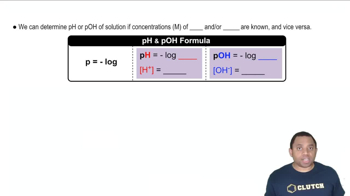
pH is a measure of the acidity or basicity of a solution, defined as the negative logarithm of the hydrogen ion concentration. A pH of 7 is neutral, below 7 is acidic, and above 7 is basic. The pOH is related to pH through the equation pH + pOH = 14, which helps in understanding the balance of hydroxide and hydrogen ions in the solution.
Video consigliato:
Percorso guidato
02:09
pH and pOH Calculations

Salt Hydrolysis

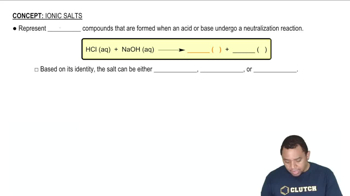
Salt hydrolysis occurs when an ionic compound dissolves in water and reacts with water to produce either acidic or basic solutions. The nature of the ions from the salt determines whether the solution will be acidic, neutral, or basic. For example, NaF produces fluoride ions that can react with water to form hydroxide ions, leading to a basic solution.
Video consigliato:

Identifying Ions in Salts

Identifying the ions present in a salt is crucial for determining its properties in solution. In this case, NaF, NaCl, and NaOCl dissociate into different ions: NaF yields Na+ and F-, NaCl yields Na+ and Cl-, and NaOCl yields Na+ and OCl-. The behavior of these ions in water, particularly their ability to affect pH, helps in identifying the unknown salt based on the measured pH.
Video consigliato: