Ch.16 - Acid-Base Equilibria
Brown - Chemistry: The Central Science 14th Edition
Brown14th EditionChemistry: The Central ScienceISBN: 9780134414232Non è quello che usi tu?Cambia libro di testo
Capitolo 16, Problema 72

Calculate the molar concentration of OH- in a 0.724 M solution of hypobromite ion BrO-; Kb = 4.0 * 10^-6. What is the pH of this solution?

Guida verificata passo dopo passo
1
Step 1: Write the equilibrium expression for the base dissociation of hypobromite ion (BrO^-). The reaction is: \[ \text{BrO}^- + \text{H}_2\text{O} \rightleftharpoons \text{OH}^- + \text{HBrO} \]
Step 2: Set up the expression for the base dissociation constant (K_b) using the concentrations of the products and reactants at equilibrium: \[ K_b = \frac{[\text{OH}^-][\text{HBrO}]}{[\text{BrO}^-]} \]
Step 3: Assume that the change in concentration of BrO^- due to dissociation is small compared to the initial concentration. Let x be the concentration of OH^- at equilibrium. Then, \[ [\text{OH}^-] = x, [\text{HBrO}] = x, [\text{BrO}^-] = 0.724 - x \approx 0.724 \]
Step 4: Substitute the equilibrium concentrations into the K_b expression and solve for x: \[ 4.0 \times 10^{-6} = \frac{x^2}{0.724} \]
Step 5: Calculate the pH of the solution using the concentration of OH^- found in the previous step. First, find the pOH: \[ \text{pOH} = -\log[\text{OH}^-] \], then use the relation \[ \text{pH} = 14 - \text{pOH} \] to find the pH.

Concetti chiave

Ecco i concetti essenziali che devi comprendere per rispondere correttamente alla domanda.

Equilibrium Constant (Kb)

The base dissociation constant (Kb) quantifies the strength of a base in solution. It is defined as the equilibrium constant for the reaction where a base accepts a proton from water, producing hydroxide ions (OH-) and the conjugate acid. A higher Kb value indicates a stronger base, which in this case helps determine the concentration of OH- ions produced from the hypobromite ion (BrO-).
Video consigliato:
Percorso guidato
01:14
Equilibrium Constant K

Hydrolysis of Hypobromite Ion

Hypobromite ion (BrO-) can undergo hydrolysis in water, reacting with water to form hydroxide ions (OH-) and hypobromous acid (HBrO). This reaction is essential for calculating the concentration of OH- in the solution. The extent of this reaction is governed by the Kb value, allowing us to set up an equilibrium expression to find the concentration of OH- ions.
Video consigliato:

pH and pOH Relationship

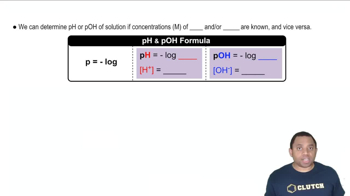
pH is a measure of the acidity or basicity of a solution, defined as the negative logarithm of the hydrogen ion concentration. Conversely, pOH measures the concentration of hydroxide ions. The relationship between pH and pOH is given by the equation pH + pOH = 14 at 25°C. Once the concentration of OH- is determined, pOH can be calculated, and subsequently, pH can be derived from this relationship.
Video consigliato:
Percorso guidato
02:09
pH and pOH Calculations