
Ch.16 - Acid-Base Equilibria
Brown - Chemistry: The Central Science 14th Edition
Brown14th EditionChemistry: The Central ScienceISBN: 9780134414232Non è quello che usi tu?Cambia libro di testo
Capitolo 16, Problema 38

Carbon dioxide in the atmosphere dissolves in raindrops to produce carbonic acid (H2CO3), causing the pH of clean, unpolluted rain to range from about 5.2 to 5.6. What are the ranges of [H+] and [OH-] in the raindrops?

Guida verificata passo dopo passo
1
Step 1: Understand the relationship between pH and [H+]. The pH of a solution is defined as the negative logarithm (base 10) of the hydrogen ion concentration: \( \text{pH} = -\log[H^+] \).
Step 2: Calculate the range of [H+] using the given pH range. For pH 5.2, use the formula \( [H^+] = 10^{-\text{pH}} \) to find the concentration of hydrogen ions. Repeat this calculation for pH 5.6.
Step 3: Understand the relationship between [H+] and [OH-] using the water dissociation constant. At 25°C, the product of the concentrations of hydrogen ions and hydroxide ions in water is constant: \( [H^+][OH^-] = 1.0 \times 10^{-14} \).
Step 4: Calculate the range of [OH-] using the [H+] values obtained in Step 2. Rearrange the equation from Step 3 to solve for [OH-]: \( [OH^-] = \frac{1.0 \times 10^{-14}}{[H^+]} \).
Step 5: Verify the consistency of your results. Ensure that the calculated [H+] and [OH-] values are consistent with the pH range and the water dissociation constant.

Concetti chiave

Ecco i concetti essenziali che devi comprendere per rispondere correttamente alla domanda.

pH Scale

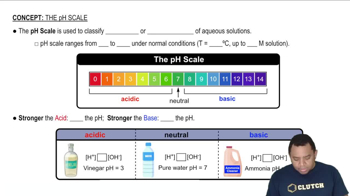
The pH scale measures the acidity or basicity of a solution, ranging from 0 to 14. A pH of 7 is neutral, while values below 7 indicate acidity and above 7 indicate basicity. The pH is inversely related to the concentration of hydrogen ions [H+]; as [H+] increases, pH decreases, indicating a more acidic solution.
Video consigliato:

Ion Product of Water

The ion product of water (Kw) is the equilibrium constant for the self-ionization of water, defined as Kw = [H+][OH-] = 1.0 x 10^-14 at 25°C. This relationship allows us to calculate the concentration of hydroxide ions [OH-] when the concentration of hydrogen ions [H+] is known, and vice versa, maintaining the balance in aqueous solutions.
Video consigliato:
Percorso guidato
00:53
Production of Hydrogen Example

Acid-Base Equilibrium

In an aqueous solution, the presence of acids and bases establishes an equilibrium between [H+] and [OH-]. For a solution with a known pH, the concentration of [H+] can be calculated using the formula [H+] = 10^(-pH). Consequently, the concentration of [OH-] can be derived from the ion product of water, ensuring that the product of [H+] and [OH-] remains constant.
Video consigliato:
Percorso guidato
6:47
Triprotic Acid Equilibrium