Ch.16 - Acid-Base Equilibria
Brown - Chemistry: The Central Science 14th Edition
Brown14th EditionChemistry: The Central ScienceISBN: 9780134414232Non è quello che usi tu?Cambia libro di testo
Capitolo 16, Problema 36

Complete the following table by calculating the missing entries. In each case, indicate whether the solution is acidic or basic.
Guida verificata passo dopo passo
1
Step 1: Identify the given information in the table, such as the concentration of hydrogen ions \([H^+]\) or hydroxide ions \([OH^-]\), and any pH or pOH values provided.
Step 2: Use the relationship between pH and \([H^+]\) to find missing values: \(pH = -\log[H^+]\). If \([H^+]\) is missing, rearrange to find \([H^+] = 10^{-pH}\).
Step 3: Use the relationship between pOH and \([OH^-]\) to find missing values: \(pOH = -\log[OH^-]\). If \([OH^-]\) is missing, rearrange to find \([OH^-] = 10^{-pOH}\).
Step 4: Use the relationship between pH and pOH: \(pH + pOH = 14\). Use this to find missing pH or pOH values if one is given.
Step 5: Determine if the solution is acidic or basic: if \(pH < 7\), the solution is acidic; if \(pH > 7\), the solution is basic.

Concetti chiave

Ecco i concetti essenziali che devi comprendere per rispondere correttamente alla domanda.

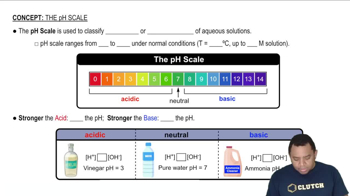
pH Scale

The pH scale measures the acidity or basicity of a solution, ranging from 0 to 14. A pH less than 7 indicates an acidic solution, while a pH greater than 7 indicates a basic solution. A pH of exactly 7 is considered neutral, typical of pure water. Understanding the pH scale is essential for determining the nature of the solutions in the table.
Video consigliato:

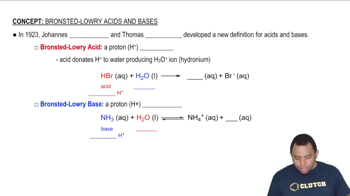
Acid-Base Theories

Acid-base theories, such as the Arrhenius, Brønsted-Lowry, and Lewis definitions, provide frameworks for identifying acids and bases. Arrhenius acids produce H⁺ ions in solution, while bases produce OH⁻ ions. Brønsted-Lowry defines acids as proton donors and bases as proton acceptors. Recognizing these definitions helps classify the solutions in the table as acidic or basic.
Video consigliato:
Percorso guidato
02:08
Bronsted-Lowry Acid-Base Theory

Neutralization Reactions

Neutralization reactions occur when an acid reacts with a base to produce water and a salt, typically resulting in a solution with a pH closer to 7. This concept is crucial for understanding how the properties of solutions change upon mixing different acids and bases. Identifying the products of these reactions can help determine the acidity or basicity of the resulting solutions in the table.
Video consigliato:
Percorso guidato
05:56
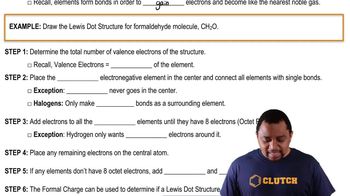
Lewis Dot Structures: Neutral Compounds