Ch.16 - Acid-Base Equilibria
Brown - Chemistry: The Central Science 14th Edition
Brown14th EditionChemistry: The Central ScienceISBN: 9780134414232Non è quello che usi tu?Cambia libro di testo
Capitolo 16, Problema 9c

Phenylephrine, an organic substance with molecular formula C9H13NO2, is used as a nasal decongenstant in over-thecounter medications. The molecular structure of phenylephrine is shown below using the usual shortcut organic structure. (c) Would you expect a solution of phenylephrine hydrochloride to be acidic, neutral, or basic?
Molecular structure of phenylephrine (C9H13NO2) for acid-base equilibrium study.

Guida verificata passo dopo passo
1
Identify the functional groups present in the phenylephrine molecule. The structure shows an aromatic ring, a hydroxyl group (-OH), and an amine group (-NH2).
Understand that phenylephrine hydrochloride is the hydrochloride salt form of phenylephrine, which means it has been reacted with hydrochloric acid (HCl).
Recognize that the amine group (-NH2) in phenylephrine can accept a proton (H+) from HCl, forming an ammonium ion (-NH3+).
Recall that ammonium ions (NH3+) are acidic in nature because they can donate a proton (H+) to the solution, making the solution acidic.
Conclude that a solution of phenylephrine hydrochloride would be expected to be acidic due to the presence of the ammonium ion.

Risposta video verificata per un problema simile:

Questa soluzione video è stata consigliata dai nostri tutor come utile per risolvere questo problema.
Durata del video:
1m

Concetti chiave

Ecco i concetti essenziali che devi comprendere per rispondere correttamente alla domanda.

Acid-Base Chemistry

Acid-base chemistry involves the study of substances that can donate protons (acids) or accept protons (bases). The pH scale measures the acidity or basicity of a solution, with values below 7 indicating acidity, 7 being neutral, and above 7 indicating basicity. Understanding the nature of the solute and its ability to donate or accept protons is crucial for predicting the pH of a solution.
Video consigliato:
Percorso guidato
02:00
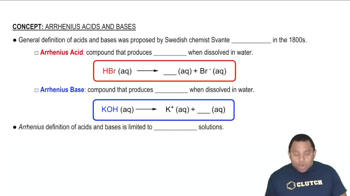
Arrhenius Acids and Bases

Ionization of Phenylephrine

Phenylephrine contains a hydroxyl group (-OH) and an amine group (-NH), which can influence its behavior in solution. When phenylephrine is dissolved in water, it can undergo ionization, where the amine group can accept a proton, forming a positively charged ion. This ionization is key to determining whether the resulting solution is acidic, neutral, or basic.
Video consigliato:
Percorso guidato
02:22
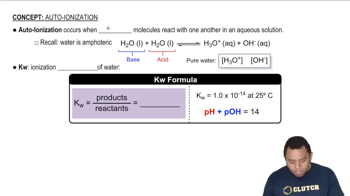
Auto-Ionization and Kw

Phenylephrine Hydrochloride

Phenylephrine hydrochloride is the hydrochloride salt form of phenylephrine, which is often more soluble in water than its base form. The presence of the hydrochloride ion (Cl-) can affect the overall pH of the solution. Typically, salts formed from weak bases and strong acids tend to create acidic solutions, which is an important consideration when evaluating the acidity of phenylephrine hydrochloride.
Video consigliato:
Percorso guidato
00:59
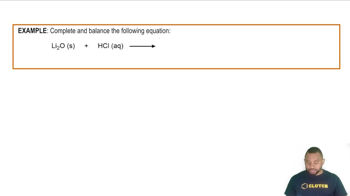
Oxide Reactions Example