Ch.16 - Acid-Base Equilibria
Brown - Chemistry: The Central Science 14th Edition
Brown14th EditionChemistry: The Central ScienceISBN: 9780134414232Non è quello che usi tu?Cambia libro di testo
Capitolo 16, Problema 103b

Predict how each molecule or ion would act, in the Brønsted-Lowry sense, in aqueous solution by writing 'acid,' 'base,' 'both,' or 'neither' on the line provided. (b) Prozac
Chemical structure of Prozac, relevant to Bronsted-Lowry acids and bases in aqueous solution.

Guida verificata passo dopo passo
1
Identify the functional groups present in the molecule. In this case, the molecule contains a carboxylic acid group (-COOH) and an ester group (-COO-).
Recall that in the Brønsted-Lowry theory, an acid is a proton (H+) donor and a base is a proton acceptor.
Analyze the carboxylic acid group (-COOH). This group can donate a proton (H+) in aqueous solution, making it act as an acid.
Consider the ester group (-COO-). Esters generally do not donate or accept protons in aqueous solution, so this group does not contribute to the molecule's behavior as an acid or base.
Conclude that the molecule, due to the presence of the carboxylic acid group, will act as an acid in aqueous solution.

Risposta video verificata per un problema simile:

Questa soluzione video è stata consigliata dai nostri tutor come utile per risolvere questo problema.
Durata del video:
38s

Concetti chiave

Ecco i concetti essenziali che devi comprendere per rispondere correttamente alla domanda.

Brønsted-Lowry Acids and Bases

The Brønsted-Lowry theory defines acids as proton donors and bases as proton acceptors. In aqueous solutions, this theory helps predict how substances will behave based on their ability to donate or accept hydrogen ions (H+). Understanding this concept is crucial for determining the acidic or basic nature of a compound, such as Prozac, in solution.
Video consigliato:
Percorso guidato
01:10
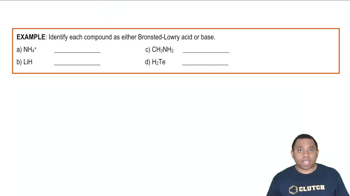
Bronsted-Lowry Acids and Bases Example

Protonation and Deprotonation

Protonation refers to the addition of a proton (H+) to a molecule, while deprotonation is the removal of a proton. These processes are fundamental in determining whether a substance acts as an acid or a base. For example, if Prozac can donate a proton from its hydroxyl (-OH) group, it may act as an acid; conversely, if it can accept a proton, it may act as a base.
Video consigliato:
Percorso guidato
01:38
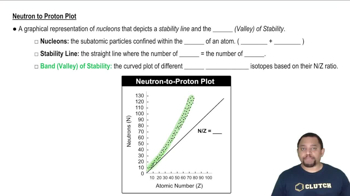
Neutron-to-Proton Plot

Aqueous Solution Behavior

The behavior of molecules in aqueous solutions is influenced by their interactions with water and the solvent's properties. Water, being a polar solvent, can stabilize ions and facilitate proton transfer. Analyzing how Prozac interacts with water can provide insights into its acidic or basic behavior, as well as its solubility and reactivity in biological systems.
Video consigliato:
Percorso guidato
01:11
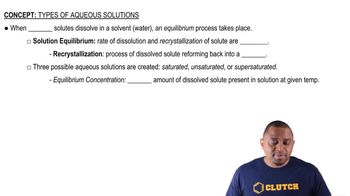
Types of Aqueous Solutions