Ch.16 - Acid-Base Equilibria
Brown - Chemistry: The Central Science 14th Edition
Brown14th EditionChemistry: The Central ScienceISBN: 9780134414232Non è quello che usi tu?Cambia libro di testo
Capitolo 16, Problema 88e

Predict the stronger acid in each pair: (e) benzoic acid (C6H5COOH) or phenol (C6H5OH).

Guida verificata passo dopo passo
1
Step 1: Understand the concept of acidity. Acidity is often related to the ability of a compound to donate a proton (H+). The stronger the acid, the more readily it donates a proton.
Step 2: Consider the structure of benzoic acid (C6H5COOH). It contains a carboxylic acid group (-COOH), which is known to be a relatively strong acidic group due to resonance stabilization of its conjugate base (benzoate ion).
Step 3: Consider the structure of phenol (C6H5OH). It contains a hydroxyl group (-OH) attached to an aromatic ring. The phenoxide ion, which is the conjugate base of phenol, is less stabilized by resonance compared to the benzoate ion.
Step 4: Compare the resonance stabilization of the conjugate bases. The benzoate ion (conjugate base of benzoic acid) is more resonance-stabilized than the phenoxide ion (conjugate base of phenol), making benzoic acid a stronger acid.
Step 5: Conclude that benzoic acid (C6H5COOH) is the stronger acid compared to phenol (C6H5OH) due to the greater resonance stabilization of its conjugate base.

Risposta video verificata per un problema simile:

Questa soluzione video è stata consigliata dai nostri tutor come utile per risolvere questo problema.
Durata del video:
1m

Concetti chiave

Ecco i concetti essenziali che devi comprendere per rispondere correttamente alla domanda.

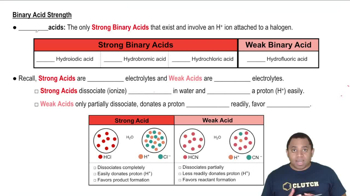
Acid Strength

Acid strength refers to the ability of an acid to donate protons (H+) in a solution. Stronger acids have a greater tendency to lose protons, resulting in a higher concentration of H+ ions in solution. This property is often quantified using the acid dissociation constant (Ka), where a larger Ka value indicates a stronger acid.
Video consigliato:
Percorso guidato
03:51
Binary Acid Strengths

Resonance Stabilization

Resonance stabilization occurs when a molecule can be represented by multiple valid Lewis structures, allowing for the delocalization of electrons. In the context of acids, resonance can stabilize the conjugate base formed after the acid donates a proton. The more stable the conjugate base, the stronger the corresponding acid, as it favors the dissociation of protons.
Video consigliato:
Percorso guidato
01:42
Resonance Structures

Inductive Effect

The inductive effect refers to the electron-withdrawing or electron-donating effects of substituents attached to a molecule. Electron-withdrawing groups can increase acid strength by stabilizing the negative charge on the conjugate base, while electron-donating groups can decrease acid strength. Understanding the inductive effects of substituents on benzoic acid and phenol is crucial for predicting their relative acid strengths.
Video consigliato:
Percorso guidato
02:31
Photoelectric Effect