Domanda del libro di testo
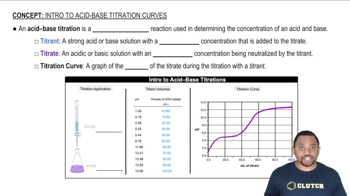
A 20.0-mL sample of 0.200 M HBr solution is titrated with 0.200 M NaOH solution. Calculate the pH of the solution after the following volumes of base have been added:
(c) 20.0 mL.
119
views

 Brown 14th EditionCh.17 - Additional Aspects of Aqueous EquilibriaProblema 44c
 Guida verificata passo dopo passo
 03:04
03:04
 02:15
02:15 05:56
05:56A 20.0-mL sample of 0.200 M HBr solution is titrated with 0.200 M NaOH solution. Calculate the pH of the solution after the following volumes of base have been added:
(c) 20.0 mL.
A 35.0-mL sample of 0.150 M acetic acid 1CH3COOH2 is titrated with 0.150 M NaOH solution. Calculate the pH after the following volumes of base have been added: (b) 17.5 mL.
A 20.0-mL sample of 0.150 M KOH is titrated with 0.125 M HClO4 solution. Calculate the pH after the following volumes of acid have been added: (a) 20.0 mL. (b) 23.0 mL.
A 20.0-mL sample of 0.150 M KOH is titrated with 0.125 M HClO4 solution. Calculate the pH after the following volumes of acid have been added: (d) 25.0 mL. (e) 30.0 mL.
A 20.0-mL sample of 0.200 M HBr solution is titrated with 0.200 M NaOH solution. Calculate the pH of the solution after the following volumes of base have been added: (e) 35.0 mL.