Ch.17 - Additional Aspects of Aqueous Equilibria
Brown - Chemistry: The Central Science 14th Edition
Brown14th EditionChemistry: The Central ScienceISBN: 9780134414232Non è quello che usi tu?Cambia libro di testo
Capitolo 17, Problema 27c

A buffer contains 0.10 mol of acetic acid and 0.13 mol of sodium acetate in 1.00 L. (c) What is the pH of the buffer after the addition of 0.02 mol of HNO3?

Guida verificata passo dopo passo
1
Identify the components of the buffer system: acetic acid (CH3COOH) and sodium acetate (CH3COONa).
Recognize that the addition of HNO3, a strong acid, will react with the acetate ion (CH3COO^-), the conjugate base in the buffer.
Calculate the moles of acetate ion (CH3COO^-) that will react with the added HNO3. Since 0.02 mol of HNO3 is added, it will react with 0.02 mol of CH3COO^-.
Subtract the moles of CH3COO^- that reacted from the initial moles of CH3COO^- to find the new concentration of CH3COO^- in the buffer.
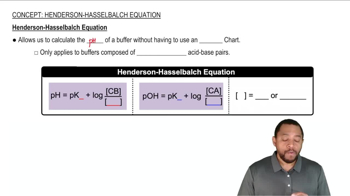
Use the Henderson-Hasselbalch equation, \( \text{pH} = \text{pK}_a + \log \left( \frac{[\text{CH}_3\text{COO}^-]}{[\text{CH}_3\text{COOH}]} \right) \), to calculate the new pH of the buffer, using the updated concentrations of CH3COOH and CH3COO^- after the reaction.

Risposta video verificata per un problema simile:

Questa soluzione video è stata consigliata dai nostri tutor come utile per risolvere questo problema.
Durata del video:
3m

Concetti chiave

Ecco i concetti essenziali che devi comprendere per rispondere correttamente alla domanda.

Buffer Solutions

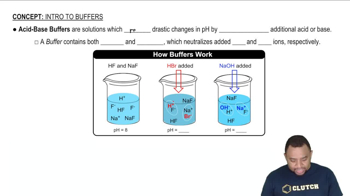
A buffer solution is a system that resists changes in pH upon the addition of small amounts of acid or base. It typically consists of a weak acid and its conjugate base, or a weak base and its conjugate acid. In this case, acetic acid (a weak acid) and sodium acetate (its conjugate base) form a buffer that can maintain pH stability when acids or bases are introduced.
Video consigliato:
Percorso guidato
03:02
Buffer Solutions

Henderson-Hasselbalch Equation

The Henderson-Hasselbalch equation is a mathematical formula used to calculate the pH of a buffer solution. It is expressed as pH = pKa + log([A-]/[HA]), where pKa is the negative logarithm of the acid dissociation constant, [A-] is the concentration of the conjugate base, and [HA] is the concentration of the weak acid. This equation helps in determining the pH after the addition of acids or bases to the buffer.
Video consigliato:
Percorso guidato
02:40
Henderson-Hasselbalch Equation

Acid-Base Neutralization

When an acid is added to a buffer solution, it reacts with the conjugate base present in the buffer, leading to a decrease in the concentration of the base and an increase in the concentration of the acid. This neutralization process is crucial for understanding how the pH of the buffer changes upon the addition of strong acids, such as HNO3 in this scenario, and is essential for calculating the new pH.
Video consigliato:
Percorso guidato
05:04
Lewis Acids and Bases