Ch.17 - Additional Aspects of Aqueous Equilibria
Brown - Chemistry: The Central Science 14th Edition
Brown14th EditionChemistry: The Central ScienceISBN: 9780134414232Non è quello che usi tu?Cambia libro di testo
Capitolo 17, Problema 18a

(a) Calculate the percent ionization of 0.125 M lactic acid (Ka = 1.4 × 10⁻⁴).

Guida verificata passo dopo passo
1
Identify the given values: concentration of lactic acid (C) = 0.125 M, and the acid dissociation constant (Ka) = 1.4 \(\times\) 10^{-4}.
Set up the expression for the equilibrium constant (Ka) for the dissociation of lactic acid, which can be represented as: Ka = \(\frac{[H^+][A^-]}{[HA]}\). Here, [HA] is the initial concentration of the acid, [H^+] is the concentration of hydrogen ions, and [A^-] is the concentration of the conjugate base at equilibrium.
Assume that the concentration of hydrogen ions produced, [H^+], is equal to x. Therefore, the concentration of the conjugate base [A^-] is also x. The concentration of the undissociated acid at equilibrium, [HA], will be the initial concentration minus x (0.125 - x).
Substitute these expressions into the Ka equation and simplify assuming x is much smaller than the initial concentration, which simplifies the denominator to just the initial concentration: Ka = \(\frac{x^2}{0.125}\).
Solve for x, which represents the concentration of hydrogen ions at equilibrium. Then, calculate the percent ionization using the formula: \(\text{Percent Ionization}\) = \(\left\)(\(\frac{[H^+]}{[HA]_{initial}\)}\(\right\)) \(\times\) 100\%.

Risposta video verificata per un problema simile:

Questa soluzione video è stata consigliata dai nostri tutor come utile per risolvere questo problema.
Durata del video:
3m

Concetti chiave

Ecco i concetti essenziali che devi comprendere per rispondere correttamente alla domanda.

Ionization of Acids

Ionization refers to the process by which an acid donates protons (H+) to water, forming hydronium ions (H3O+). For weak acids like lactic acid, this process is not complete, and only a fraction of the acid molecules ionize. The extent of ionization is crucial for calculating properties like percent ionization.
Video consigliato:
Percorso guidato
01:15
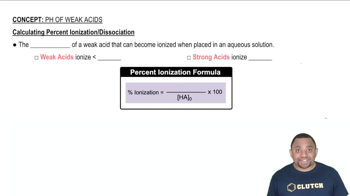
Calculating Percent Ionization of Weak Acids

Percent Ionization

Percent ionization is a measure of the degree to which an acid ionizes in solution, expressed as a percentage. It is calculated using the formula: (concentration of ionized acid / initial concentration of acid) × 100%. This value helps in understanding the strength of the acid and its behavior in solution.
Video consigliato:
Percorso guidato
06:08
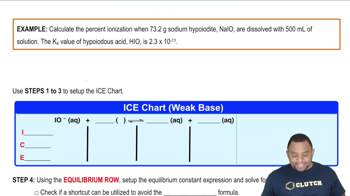
Percent Ionization Example

Equilibrium Constant (Ka)

The equilibrium constant (Ka) quantifies the strength of an acid in solution, representing the ratio of the concentration of products to reactants at equilibrium. A smaller Ka value indicates a weaker acid, as seen with lactic acid's Ka of 1.4 × 10^-4, which suggests limited ionization and helps in calculating the percent ionization.
Video consigliato:
Percorso guidato
01:14
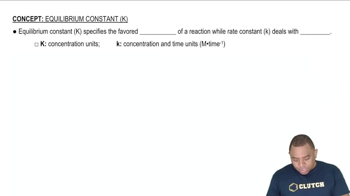
Equilibrium Constant K