
A sample of 0.1687 g of an unknown monoprotic acid was dissolved in 25.0 mL of water and titrated with 0.1150 M NaOH. The acid required 15.5 mL of base to reach the equivalence point. (b) After 7.25 mL of base had been added in the titration, the pH was found to be 2.85. What is the Ka for the unknown acid?
Ch.17 - Additional Aspects of Aqueous Equilibria
Brown14th EditionChemistry: The Central ScienceISBN: 9780134414232Non è quello che usi tu?Cambia libro di testo
Tutti i libri di testo
Brown 14th Edition
Ch.17 - Additional Aspects of Aqueous Equilibria
Problema 91a
Brown 14th Edition
Ch.17 - Additional Aspects of Aqueous Equilibria
Problema 91aCapitolo 17, Problema 91a
A sample of 0.1687 g of an unknown monoprotic acid was dissolved in 25.0 mL of water and titrated with 0.1150 M NaOH. The acid required 15.5 mL of base to reach the equivalence point. (a) What is the molar mass of the acid?
Guida verificata passo dopo passo1
Start by understanding that the equivalence point in a titration is reached when the moles of acid equal the moles of base added. Since the acid is monoprotic, it donates one proton per molecule.
Calculate the moles of NaOH used in the titration. Use the formula: \( \text{moles of NaOH} = \text{volume (L)} \times \text{molarity (M)} \). Convert 15.5 mL to liters by dividing by 1000.
Since the moles of NaOH equal the moles of the unknown acid at the equivalence point, the moles of the acid are the same as the moles of NaOH calculated in the previous step.
Determine the molar mass of the acid using the formula: \( \text{molar mass} = \frac{\text{mass of acid (g)}}{\text{moles of acid}} \). Use the mass of the acid given (0.1687 g) and the moles of acid calculated.
Ensure all units are consistent and check your calculations for accuracy. The molar mass will be in units of g/mol.

Risposta video verificata per un problema simile:
Questa soluzione video è stata consigliata dai nostri tutor come utile per risolvere questo problema.
Durata del video:
3mConcetti chiave
Ecco i concetti essenziali che devi comprendere per rispondere correttamente alla domanda.
Monoprotic Acid
A monoprotic acid is an acid that can donate only one proton (H⁺ ion) per molecule during a chemical reaction. This characteristic simplifies titration calculations, as the amount of base required to neutralize the acid directly relates to the number of moles of the acid present in the solution.
Video consigliato:
Percorso guidato
Binary Acids
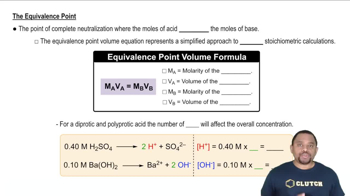
Titration and Equivalence Point
Titration is a quantitative analytical method used to determine the concentration of a solute in a solution. The equivalence point is reached when the amount of titrant added is stoichiometrically equivalent to the amount of substance being titrated, indicating that the acid has been completely neutralized by the base.
Video consigliato:
Percorso guidato
Equivalence Point in Titration
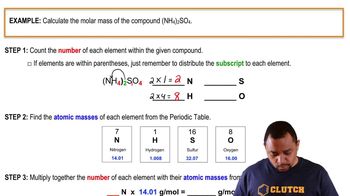
Molar Mass Calculation
Molar mass is the mass of one mole of a substance, typically expressed in grams per mole (g/mol). To calculate the molar mass of the unknown acid, one must first determine the number of moles of acid neutralized at the equivalence point using the volume and concentration of the titrant, and then relate this to the mass of the acid sample.
Video consigliato:
Percorso guidato
Molar Mass Calculation Example
Pratica correlata
Domanda del libro di testo
2137
views
1
rank
Domanda del libro di testo
A sample of 0.2140 g of an unknown monoprotic acid was dissolved in 25.0 mL of water and titrated with 0.0950 M NaOH. The acid required 30.0 mL of base to reach the equivalence point. (a) What is the molar mass of the acid?
1096
views
Domanda del libro di testo
Mathematically prove that the pH at the halfway point of
a titration of a weak acid with a strong base (where the volume
of added base is half of that needed to reach the equivalence
point) is equal to pKa for the acid.
567
views
Domanda del libro di testo
Two buffers are prepared by adding an equal number of moles of formic acid (HCOOH) and sodium formate (HCOONa) to enough water to make 1.00 L of solution. Buffer A is prepared using 1.00 mol each of formic acid and sodium formate. Buffer B is prepared by using 0.010 mol of each. (b) Which buffer will have the greater buffer capacity?
1550
views