
Ch.17 - Additional Aspects of Aqueous Equilibria
Brown - Chemistry: The Central Science 14th Edition
Brown14th EditionChemistry: The Central ScienceISBN: 9780134414232Non è quello che usi tu?Cambia libro di testo
Capitolo 17, Problema 104

A solid sample of Fe1OH23 is added to 0.500 L of 0.250 M aqueous H2SO4. The solution that remains is still acidic. It is then titrated with 0.500 M NaOH solution, and it takes 12.5 mL of the NaOH solution to reach the equivalence point. What mass of Fe1OH23 was added to the H2SO4 solution?

Guida verificata passo dopo passo
1
Step 1: Identify the balanced chemical equations for the reactions. The Fe(OH)2 reacts with H2SO4 to form FeSO4 and water. The remaining H2SO4 is then neutralized by NaOH to form Na2SO4 and water.
Step 2: Calculate the moles of NaOH used in the titration. This can be done by multiplying the volume (in liters) by the molarity of the NaOH solution.
Step 3: Use stoichiometry to determine the moles of H2SO4 that were neutralized by the NaOH. Since the reaction between H2SO4 and NaOH is a 1:2 ratio, the moles of H2SO4 will be half the moles of NaOH.
Step 4: Subtract the moles of H2SO4 that reacted with NaOH from the initial moles of H2SO4 (which can be calculated from the initial volume and molarity) to find the moles of H2SO4 that reacted with Fe(OH)2.
Step 5: Use stoichiometry to calculate the moles of Fe(OH)2 that reacted with H2SO4. Since the reaction between Fe(OH)2 and H2SO4 is a 1:1 ratio, the moles of Fe(OH)2 will be the same as the moles of H2SO4 that reacted with it. Then, convert the moles of Fe(OH)2 to grams using its molar mass to find the mass of Fe(OH)2 that was added to the H2SO4 solution.

Risposta video verificata per un problema simile:

Questa soluzione video è stata consigliata dai nostri tutor come utile per risolvere questo problema.
Durata del video:
6m

Concetti chiave

Ecco i concetti essenziali che devi comprendere per rispondere correttamente alla domanda.

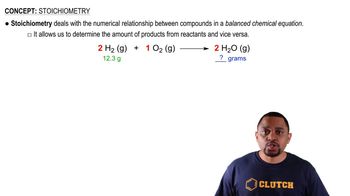
Stoichiometry

Stoichiometry is the calculation of reactants and products in chemical reactions. It involves using balanced chemical equations to determine the relationships between the amounts of substances consumed and produced. In this question, stoichiometry is essential for relating the moles of H2SO4 and NaOH to the moles of Fe(OH)2 involved in the reaction.
Video consigliato:
Percorso guidato
01:16
Stoichiometry Concept

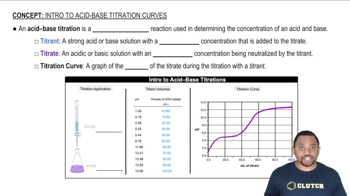
Titration

Titration is a laboratory technique used to determine the concentration of a solution by reacting it with a solution of known concentration. In this scenario, the titration of the acidic solution with NaOH allows for the determination of the amount of acid present, which can then be used to find the mass of Fe(OH)2. The equivalence point indicates that the acid and base have reacted completely.
Video consigliato:
Percorso guidato
03:04
Acid-Base Titration

Molar Mass

Molar mass is the mass of one mole of a substance, typically expressed in grams per mole (g/mol). It is crucial for converting between moles and grams in stoichiometric calculations. To find the mass of Fe(OH)2 added to the H2SO4 solution, one must first calculate the moles of Fe(OH)2 based on the titration results and then use its molar mass to convert moles to grams.
Video consigliato:
Percorso guidato
02:11
Molar Mass Concept