
You have to prepare a pH = 3.50 buffer, and you have the following 0.10 M solutions available: HCOOH, CH3COOH, H3PO4, HCOONa, CH3COONa, and NaH2PO4. How many milliliters of each solution would you use to make approximately 1 L of the buffer?
Ch.17 - Additional Aspects of Aqueous Equilibria
Brown14th EditionChemistry: The Central ScienceISBN: 9780134414232Non è quello che usi tu?Cambia libro di testo
Tutti i libri di testo
Brown 14th Edition
Ch.17 - Additional Aspects of Aqueous Equilibria
Problema 29a
Brown 14th Edition
Ch.17 - Additional Aspects of Aqueous Equilibria
Problema 29aCapitolo 17, Problema 29a
(a) What is the ratio of HCO3- to H2CO3 in blood of pH 7.4?
Guida verificata passo dopo passo1
Identify the relevant chemical species involved, which are bicarbonate ion (HCO3-) and carbonic acid (H2CO3).
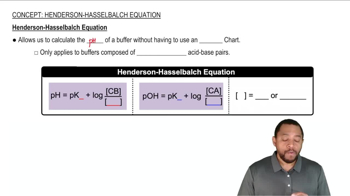
Recognize that the relationship between these species in solution can be described by the Henderson-Hasselbalch equation: pH = pKa + log([A-]/[HA]), where A- is the conjugate base (HCO3-) and HA is the acid (H2CO3).
Find the pKa value for the dissociation of H2CO3 into HCO3-. This value is typically around 6.1 for carbonic acid.
Substitute the known values into the Henderson-Hasselbalch equation: 7.4 = 6.1 + log([HCO3-]/[H2CO3]).
Solve the equation for the ratio [HCO3-]/[H2CO3] by isolating the ratio on one side of the equation.

Risposta video verificata per un problema simile:
Questa soluzione video è stata consigliata dai nostri tutor come utile per risolvere questo problema.
Durata del video:
2mConcetti chiave
Ecco i concetti essenziali che devi comprendere per rispondere correttamente alla domanda.
Buffer Systems
Buffer systems in biological fluids, such as blood, help maintain pH stability. The bicarbonate (HCO3-) and carbonic acid (H2CO3) system is a crucial buffer that resists changes in pH by neutralizing excess acids or bases. This balance is vital for physiological processes, as even slight deviations in pH can affect enzyme activity and metabolic functions.
Video consigliato:
Percorso guidato
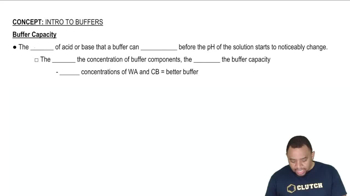
Buffer Capacity
Henderson-Hasselbalch Equation
The Henderson-Hasselbalch equation relates the pH of a solution to the concentration ratio of an acid and its conjugate base. For the bicarbonate buffer system, it is expressed as pH = pKa + log([HCO3-]/[H2CO3]). This equation allows for the calculation of the ratio of bicarbonate to carbonic acid at a given pH, which is essential for understanding acid-base balance in the blood.
Video consigliato:
Percorso guidato
Henderson-Hasselbalch Equation
Physiological pH and Homeostasis
Physiological pH refers to the normal pH range of human blood, which is approximately 7.35 to 7.45. Maintaining this pH is crucial for homeostasis, as it ensures optimal conditions for biochemical reactions. Deviations from this range can lead to acidosis or alkalosis, conditions that can disrupt cellular functions and overall health.
Video consigliato:
Percorso guidato
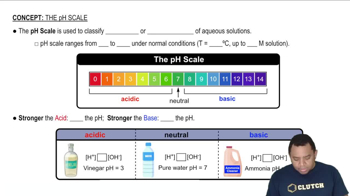
The pH Scale
Pratica correlata
Domanda del libro di testo
(b) What is the ratio of HCO3- to H2CO3 in an exhausted marathon runner whose blood pH is 7.1?
542
views
Domanda del libro di testo
A buffer contains 0.10 mol of acetic acid and 0.13 mol of sodium acetate in 1.00 L. (c) What is the pH of the buffer after the addition of 0.02 mol of HNO3?
585
views
Domanda del libro di testo
A buffer contains 0.10 mol of acetic acid and 0.13 mol of sodium acetate in 1.00 L. (b) What is the pH of the buffer after the addition of 0.02 mol of KOH?
1041
views
Domanda del libro di testo
You have to prepare a pH = 3.50 buffer, and you have the following 0.10 M solutions available: HCOOH, CH3COOH, H3PO4, HCOONa, CH3COONa, and NaH2PO4. Which solutions would you use?
1852
views
1
rank