Domanda del libro di testo
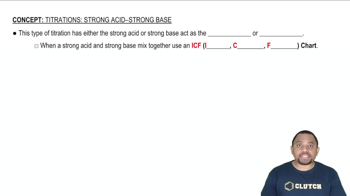
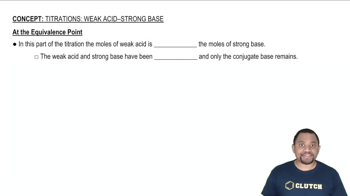
Predict whether the equivalence point of each of the following titrations is below, above, or at pH 7: (b) calcium hydroxide titrated with perchloric acid.
443
views

 Brown 14th EditionCh.17 - Additional Aspects of Aqueous EquilibriaProblema 40b
 Guida verificata passo dopo passo
 01:09
01:09
 01:07
01:07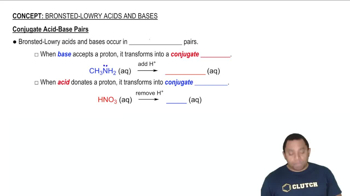 01:30
01:30Predict whether the equivalence point of each of the following titrations is below, above, or at pH 7: (b) calcium hydroxide titrated with perchloric acid.
Predict whether the equivalence point of each of the following titrations is below, above, or at pH 7: (c) pyridine titrated with nitric acid.
Assume that 30.0 mL of a 0.10 M solution of a weak base B that accepts one proton is titrated with a 0.10 M solution of the monoprotic strong acid HA. (a) How many moles of HA have been added at the equivalence point?
How many milliliters of 0.0850 M NaOH are required to titrate each of the following solutions to the equivalence point: (b) 35.0 mL of 0.0850 M CH3COOH?
Assume that 30.0 mL of a 0.10 M solution of a weak base B that accepts one proton is titrated with a 0.10 M solution of the monoprotic strong acid HA. (c) Is the pH 7, less than 7, or more than 7 at the equivalence point?
How many milliliters of 0.0850 M NaOH are required to titrate each of the following solutions to the equivalence point: (c) 50.0 mL of a solution that contains 1.85 g of HCl per liter?