
Ch.17 - Additional Aspects of Aqueous Equilibria
Brown - Chemistry: The Central Science 14th Edition
Brown14th EditionChemistry: The Central ScienceISBN: 9780134414232Non è quello che usi tu?Cambia libro di testo
Capitolo 17, Problema 71

Calculate the minimum pH needed to precipitate Mn1OH22 so completely that the concentration of Mn2 +1aq2 is less than 1 mg per liter [1 part per billion (ppb)].

Guida verificata passo dopo passo
1
Step 1: Write down the solubility product expression for the precipitation reaction. For Mn(OH)2, the reaction is: Mn(OH)2(s) ⇌ Mn2+(aq) + 2OH-(aq). The solubility product constant, Ksp, is given by Ksp = [Mn2+][OH-]^2.
Step 2: Convert the given concentration of Mn2+ from mg/L to mol/L. 1 mg/L is equivalent to 1e-6 g/L. Using the molar mass of Mn2+ (54.94 g/mol), you can convert this to mol/L.
Step 3: Substitute the concentration of Mn2+ into the Ksp expression. Since the stoichiometry of the reaction shows that for every 1 Mn2+ ion, there are 2 OH- ions, the concentration of OH- is twice that of Mn2+.
Step 4: Solve the Ksp expression for [OH-]. You can look up the Ksp value for Mn(OH)2 in a table or it may be given in the problem.
Step 5: Convert the concentration of OH- to pH. First, calculate the pOH by taking the negative logarithm of the [OH-]. Then, use the relationship pH + pOH = 14 (at 25°C) to find the pH.

Risposta video verificata per un problema simile:

Questa soluzione video è stata consigliata dai nostri tutor come utile per risolvere questo problema.
Durata del video:
6m

Concetti chiave

Ecco i concetti essenziali che devi comprendere per rispondere correttamente alla domanda.

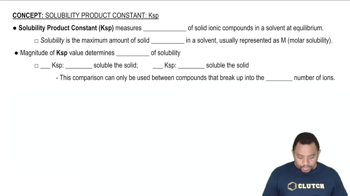
Solubility Product Constant (Ksp)

The solubility product constant (Ksp) is an equilibrium constant that applies to the solubility of sparingly soluble ionic compounds. It represents the product of the molar concentrations of the ions, each raised to the power of their coefficients in the balanced equation. For Mn(OH)2, Ksp can be used to determine the conditions under which the compound will precipitate, particularly in relation to pH and ion concentration.
Video consigliato:
Percorso guidato
01:47
Solubility Product Constant

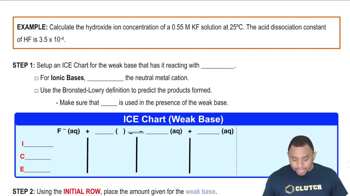
pH and Hydroxide Ion Concentration

pH is a measure of the acidity or basicity of a solution, defined as the negative logarithm of the hydrogen ion concentration. In the context of precipitating Mn(OH)2, increasing the pH leads to a higher concentration of hydroxide ions (OH-), which can react with Mn2+ ions to form the insoluble compound. Understanding the relationship between pH and hydroxide ion concentration is crucial for controlling precipitation.
Video consigliato:
Percorso guidato
06:12
Hydroxide Ion Concentration Example

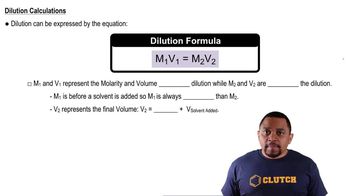
Concentration Units and Dilution

Concentration units, such as parts per billion (ppb), are essential for quantifying the amount of a substance in a solution. In this case, achieving a concentration of Mn2+ less than 1 mg/L (1 ppb) requires careful calculation of the necessary pH to ensure that the solubility of Mn(OH)2 is exceeded. Understanding how to convert and manipulate concentration units is vital for solving the problem effectively.
Video consigliato:
Percorso guidato
00:58
Dilution Equation