Calculate the pH at the equivalence point in titrating 0.100 M solutions of each of the following with 0.080 M NaOH: (c) benzoic acid (C6H5COOH).
Ch.17 - Additional Aspects of Aqueous Equilibria
Brown14th EditionChemistry: The Central ScienceISBN: 9780134414232Non è quello che usi tu?Cambia libro di testo
Tutti i libri di testo
Brown 14th Edition
Ch.17 - Additional Aspects of Aqueous Equilibria
Problema 48b
Brown 14th Edition
Ch.17 - Additional Aspects of Aqueous Equilibria
Problema 48bCapitolo 17, Problema 48b
Calculate the pH at the equivalence point in titrating 0.100 M solutions of each of the following with 0.080 M NaOH: (b) chlorous acid (HClO2).
Guida verificata passo dopo passo1
Identify the type of titration: This is a weak acid (HClO_2) being titrated with a strong base (NaOH).
At the equivalence point, all the weak acid (HClO_2) has been converted to its conjugate base (ClO_2^-).
Calculate the concentration of the conjugate base (ClO_2^-) at the equivalence point using the initial concentrations and volumes of the acid and base.
Use the hydrolysis of the conjugate base (ClO_2^-) to find the concentration of OH^- ions: ClO_2^- + H_2O \(\rightleftharpoons\) HClO_2 + OH^-.
Calculate the pOH from the concentration of OH^- ions, and then find the pH using the relation pH + pOH = 14.

Risposta video verificata per un problema simile:
Questa soluzione video è stata consigliata dai nostri tutor come utile per risolvere questo problema.
Durata del video:
9mConcetti chiave
Ecco i concetti essenziali che devi comprendere per rispondere correttamente alla domanda.
Titration and Equivalence Point
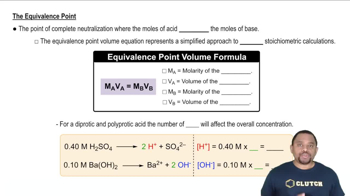
Titration is a quantitative analytical method used to determine the concentration of a solute in a solution. The equivalence point occurs when the amount of titrant added is stoichiometrically equivalent to the amount of analyte in the solution, resulting in complete neutralization. At this point, the pH of the solution is determined by the properties of the resulting products, rather than the original acid or base.
Video consigliato:
Percorso guidato
Equivalence Point in Titration
Weak Acid and Its Conjugate Base
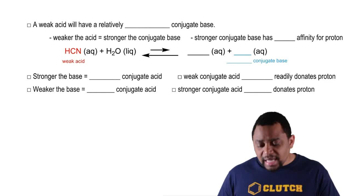
Chlorous acid (HClO2) is a weak acid that partially dissociates in solution. At the equivalence point of its titration with a strong base like NaOH, the resulting solution contains the conjugate base (ClO2-) of the weak acid. The pH at this point is influenced by the hydrolysis of the conjugate base, which can affect the concentration of hydroxide ions in the solution, thus impacting the overall pH.
Video consigliato:
Percorso guidato
Conjugate Acid-Base Relationships
pH Calculation from Hydrolysis
To calculate the pH at the equivalence point, one must consider the hydrolysis of the conjugate base formed during the titration. The equilibrium established by the hydrolysis reaction can be described by the Kb expression, which relates the concentrations of the products and reactants. By determining the concentration of hydroxide ions produced and converting this to pH, one can accurately find the pH of the solution at the equivalence point.
Video consigliato:
Percorso guidato
pH Calculation Example
Pratica correlata
Domanda del libro di testo
653
views
Domanda del libro di testo
The solubility of two slightly soluble salts of M2 + , MA and MZ2, is the same, 4 * 10-4 mol/L. (c) If you added an equal volume of a solution saturated in MA to one saturated in MZ2, what would be the equilibrium concentration of the cation, M2+?
857
views
1
rank
Domanda del libro di testo
Calculate the pH at the equivalence point for titrating 0.200 M solutions of each of the following bases with 0.200 M HBr: (b) hydroxylamine 1NH2OH2.
1413
views
Domanda del libro di testo
Calculate the pH at the equivalence point in titrating 0.100 M solutions of each of the following with 0.080 M NaOH: (a) hydrobromic acid (HBr).
1315
views
Domanda del libro di testo
Calculate the pH at the equivalence point for titrating 0.200 M solutions of each of the following bases with 0.200 M HBr: (a) sodium hydroxide (NaOH).