
Three cations, Ni2+ , Cu2+ , and Ag+, are separated using two different precipitating agents. Based on Figure 17.23, what two precipitating agents could be used? Using these agents, indicate which of the cations is A, which is B, and which is C.[Section 17.7]
Ch.17 - Additional Aspects of Aqueous Equilibria
Brown14th EditionChemistry: The Central ScienceISBN: 9780134414232Non è quello che usi tu?Cambia libro di testo
Tutti i libri di testo
Brown 14th Edition
Ch.17 - Additional Aspects of Aqueous Equilibria
Problema 14c
Brown 14th Edition
Ch.17 - Additional Aspects of Aqueous Equilibria
Problema 14cCapitolo 17, Problema 14c
Consider the equilibrium B(aq) + H2O(l) ⇌ HB+(aq) + OH–(aq). Suppose that a salt of HB+(aq) is added to a solution of B(aq) at equilibrium. (c) Will the pH of the solution increase, decrease, or stay the same?
Guida verificata passo dopo passo1
Step 1: Understand the equilibrium reaction. The reaction B1aq2 + H2O1l2 Δ HB+1aq2 + OH-1aq2 is an acid-base reaction where B1aq2 acts as a base and H2O1l2 acts as an acid. The products are the conjugate acid HB+1aq2 and the conjugate base OH-1aq2.
Step 2: Identify the change in the system. The problem states that a salt of HB+1aq2 is added to the solution. This means that the concentration of HB+1aq2 in the solution increases.
Step 3: Apply Le Chatelier's Principle. According to Le Chatelier's Principle, when a change is applied to a system at equilibrium, the system will shift to counteract that change. In this case, the increase in HB+1aq2 will cause the equilibrium to shift to the left to reduce the concentration of HB+1aq2.
Step 4: Determine the effect on OH-1aq2. As the equilibrium shifts to the left, the concentration of OH-1aq2 will decrease because it is a product of the reaction and the reaction is moving in the reverse direction.
Step 5: Relate the change in OH-1aq2 to pH. The pH of a solution is related to the concentration of OH-1aq2 in the solution. As the concentration of OH-1aq2 decreases, the pH of the solution will also decrease. Therefore, the pH of the solution will decrease when a salt of HB+1aq2 is added to the solution.

Risposta video verificata per un problema simile:
Questa soluzione video è stata consigliata dai nostri tutor come utile per risolvere questo problema.
Durata del video:
1mConcetti chiave
Ecco i concetti essenziali che devi comprendere per rispondere correttamente alla domanda.
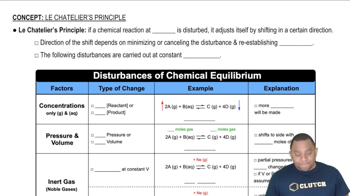
Le Chatelier's Principle
Le Chatelier's Principle states that if a dynamic equilibrium is disturbed by changing the conditions, the system will adjust to counteract the change and restore a new equilibrium. In this case, adding a salt of HB+ will increase the concentration of HB+, shifting the equilibrium to the left to reduce the concentration of HB+ and OH-.
Video consigliato:
Percorso guidato
Le Chatelier's Principle
Acid-Base Equilibrium
Acid-base equilibrium involves the balance between acids and bases in a solution, which affects the pH. In this equilibrium, HB+ acts as an acid, donating protons (H+) to the solution, while B- acts as a base. The addition of HB+ will influence the concentration of H+ ions, thereby affecting the pH.
Video consigliato:
Percorso guidato
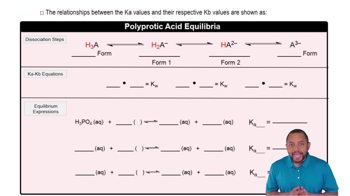
Triprotic Acid Equilibrium
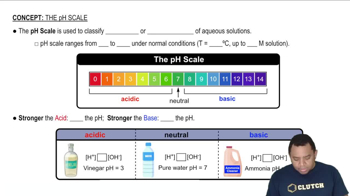
pH Scale
The pH scale measures the acidity or basicity of a solution, ranging from 0 (very acidic) to 14 (very basic), with 7 being neutral. A decrease in pH indicates an increase in H+ concentration, while an increase in pH indicates a decrease in H+ concentration. Understanding how the addition of HB+ affects H+ concentration is crucial for predicting changes in pH.
Video consigliato:
Percorso guidato
The pH Scale
Pratica correlata
Domanda del libro di testo
423
views
Domanda del libro di testo
(a) Calculate the percent ionization of 0.0075 M butanoic acid 1Ka = 1.5 * 10-52.
618
views
Domanda del libro di testo
Which of these statements about the common-ion effect is most correct? (a) The solubility of a salt MA is decreased in a solution that already contains either M+ or A-. (b) Common ions alter the equilibrium constant for the reaction of an ionic solid with water. (c) The common-ion effect does not apply to unusual ions like SO32 - . (d) The solubility of a salt MA is affected equally by the addition of either A- or a noncommon ion.
999
views