Ch.17 - Additional Aspects of Aqueous Equilibria
Brown - Chemistry: The Central Science 14th Edition
Brown14th EditionChemistry: The Central ScienceISBN: 9780134414232Non è quello che usi tu?Cambia libro di testo
Capitolo 17, Problema 42b

How many milliliters of 0.105 M HCl are needed to titrate each of the following solutions to the equivalence point: (b) 22.5 mL of 0.118 M NH3?

Guida verificata passo dopo passo
1
Identify the balanced chemical equation for the reaction: \[ \text{NH}_3 + \text{HCl} \rightarrow \text{NH}_4\text{Cl} \].
Determine the moles of \( \text{NH}_3 \) present in the solution using the formula: \[ \text{moles of NH}_3 = M_1 \times V_1 \], where \( M_1 = 0.118 \text{ M} \) and \( V_1 = 22.5 \text{ mL} \) (convert \( V_1 \) to liters).
Since the reaction is a 1:1 molar ratio, the moles of \( \text{HCl} \) needed will be equal to the moles of \( \text{NH}_3 \).
Use the moles of \( \text{HCl} \) to find the volume of \( 0.105 \text{ M} \) \( \text{HCl} \) required: \[ V_2 = \frac{\text{moles of HCl}}{M_2} \], where \( M_2 = 0.105 \text{ M} \).
Convert the volume \( V_2 \) from liters to milliliters to find the final answer.

Risposta video verificata per un problema simile:

Questa soluzione video è stata consigliata dai nostri tutor come utile per risolvere questo problema.
Durata del video:
3m

Concetti chiave

Ecco i concetti essenziali che devi comprendere per rispondere correttamente alla domanda.

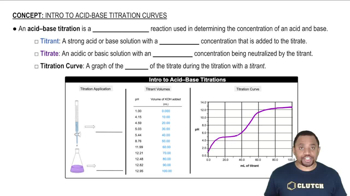
Titration

Titration is a quantitative analytical technique used to determine the concentration of a solute in a solution. It involves the gradual addition of a titrant (a solution of known concentration) to a sample solution until the reaction reaches its equivalence point, where the amount of titrant equals the amount of substance in the sample. This process is often indicated by a color change or a pH change, depending on the type of titration.
Video consigliato:
Percorso guidato
03:04
Acid-Base Titration

Molarity (M)

Molarity is a measure of concentration defined as the number of moles of solute per liter of solution. It is expressed in moles per liter (mol/L) and is crucial for calculations in titration, as it allows for the determination of how much of a reactant is needed to completely react with a given volume of another reactant. Understanding molarity is essential for accurately calculating the volumes required in titration experiments.
Video consigliato:
Percorso guidato
00:53
Molarity Concept

Neutralization Reaction

A neutralization reaction occurs when an acid reacts with a base to produce water and a salt. In the context of titration, the acid (HCl) and the base (NH3) react in a stoichiometric ratio, which is determined by their balanced chemical equation. For strong acids and weak bases, the equivalence point is reached when the number of moles of acid equals the number of moles of base, allowing for the calculation of the required volume of acid to achieve neutralization.
Video consigliato:
Percorso guidato
05:56
Lewis Dot Structures: Neutral Compounds