Ch.17 - Additional Aspects of Aqueous Equilibria
Brown - Chemistry: The Central Science 14th Edition
Brown14th EditionChemistry: The Central ScienceISBN: 9780134414232Non è quello che usi tu?Cambia libro di testo
Capitolo 17, Problema 5b

The following figure represents solutions at various stages of the titration of a weak acid, HA, with NaOH. (The Na+ ions and water molecules have been omitted for clarity.) To which of the following regions of the titration curve does each drawing correspond: (b) after addition of NaOH but before the equivalence point? [Section 17.3]
Illustration of weak acid titration stages with NaOH, focusing on stage (b) before equivalence point.

Guida verificata passo dopo passo
1
Identify the species present in each stage of the titration: HA (weak acid), A^- (conjugate base), and OH^- (hydroxide ion).
Understand that before the equivalence point, the solution contains both the weak acid (HA) and its conjugate base (A^-), but not significant amounts of OH^-.
Analyze the images: (a) shows only HA, (b) shows both HA and A^-, (c) shows A^-, HA, and OH^-, and (d) shows mostly HA and A^- with some OH^-.
Determine that image (b) corresponds to the stage after the addition of NaOH but before the equivalence point, as it shows both HA and A^- without significant OH^- presence.
Conclude that image (b) represents the solution after the addition of NaOH but before the equivalence point in the titration curve.

Risposta video verificata per un problema simile:

Questa soluzione video è stata consigliata dai nostri tutor come utile per risolvere questo problema.
Durata del video:
2m

Concetti chiave

Ecco i concetti essenziali che devi comprendere per rispondere correttamente alla domanda.

Titration Curve

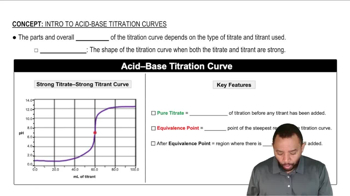
A titration curve is a graphical representation of the pH of a solution as a function of the volume of titrant added. In the case of a weak acid being titrated with a strong base, the curve typically shows a gradual increase in pH, with a steep rise near the equivalence point. Understanding the shape of the curve helps in identifying different stages of the titration process, including the region before the equivalence point.
Video consigliato:
Percorso guidato
02:16
Acid-Base Titration Curves

Weak Acid and Conjugate Base

A weak acid, such as HA, partially dissociates in solution to form its conjugate base (A-) and hydrogen ions (H+). During titration with a strong base like NaOH, the weak acid reacts with hydroxide ions (OH-) to form water and its conjugate base. This equilibrium is crucial for understanding the composition of the solution at various points in the titration, particularly before reaching the equivalence point.
Video consigliato:
Percorso guidato
01:46
Conjugate Acid-Base Relationships

Equivalence Point

The equivalence point in a titration is the stage at which the amount of titrant added is stoichiometrically equivalent to the amount of substance present in the solution. For a weak acid titrated with a strong base, this point is characterized by a significant change in pH and the complete conversion of the weak acid to its conjugate base. Recognizing the region before this point is essential for analyzing the titration curve and the solution's composition.
Video consigliato:
Percorso guidato
01:07
At the Equivalence Point