
Ch.18 - Chemistry of the Environment
Brown - Chemistry: The Central Science 14th Edition
Brown14th EditionChemistry: The Central ScienceISBN: 9780134414232Non è quello che usi tu?Cambia libro di testo
Capitolo 18, Problema 53

(a) What are trihalomethanes (THMs)? (b) Draw the Lewis structures of two example THMs.

Guida verificata passo dopo passo
1
Step 1: Understand what THMs are. THMs, or Trihalomethanes, are a group of organic compounds that contain one carbon atom and three halogen atoms. The halogens can be any of the following: fluorine (F), chlorine (Cl), bromine (Br), or iodine (I).
Step 2: Choose two THMs to draw. For this example, let's choose trichloromethane (CHCl3) and tribromomethane (CHBr3).
Step 3: Draw the Lewis structure for trichloromethane (CHCl3). Start by drawing the carbon atom in the center, as carbon is less electronegative. Then, draw a single bond to the hydrogen atom and three single bonds to the three chlorine atoms. Each chlorine atom should have three lone pairs of electrons, and the hydrogen atom does not have any lone pairs.
Step 4: Draw the Lewis structure for tribromomethane (CHBr3). The process is similar to step 3. Start by drawing the carbon atom in the center, then draw a single bond to the hydrogen atom and three single bonds to the three bromine atoms. Each bromine atom should have three lone pairs of electrons, and the hydrogen atom does not have any lone pairs.
Step 5: Review your Lewis structures. Make sure that each atom has a full octet (except for hydrogen, which only needs two electrons), and that the total number of electrons equals the sum of the valence electrons of each atom.

Risposta video verificata per un problema simile:

Questa soluzione video è stata consigliata dai nostri tutor come utile per risolvere questo problema.
Durata del video:
3m

Concetti chiave

Ecco i concetti essenziali che devi comprendere per rispondere correttamente alla domanda.

Lewis Structures

Lewis structures are diagrams that represent the bonding between atoms in a molecule and the lone pairs of electrons that may exist. They use dots to represent electrons and lines to represent bonds between atoms. Understanding how to draw Lewis structures is essential for visualizing molecular geometry and predicting the reactivity of compounds.
Video consigliato:
Percorso guidato
04:28
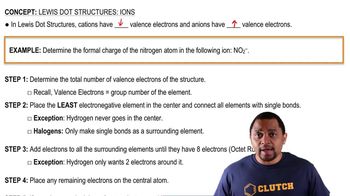
Lewis Dot Structures: Ions

Trihalomethanes (THMs)

Trihalomethanes (THMs) are a group of chemical compounds that consist of a methane molecule (CH4) where three of the hydrogen atoms are replaced by halogen atoms (such as chlorine, bromine, or iodine). They are commonly formed as byproducts in water chlorination processes and are important in environmental chemistry due to their potential health effects.

Valence Electrons

Valence electrons are the outermost electrons of an atom and are crucial in determining how an atom bonds with others. The number of valence electrons influences the atom's reactivity and the types of bonds it can form. In drawing Lewis structures, accurately accounting for valence electrons is vital to depict the correct bonding and electron arrangement in molecules.
Video consigliato:
Percorso guidato
02:12
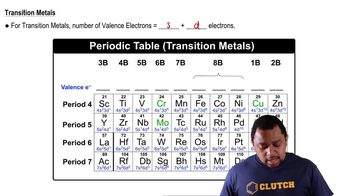
Transition Metals Valence Electrons