
Air pollution in the Mexico City metropolitan area is among the worst in the world. The concentration of ozone in Mexico City has been measured at 441 ppb (0.441 ppm). Mexico City sits at an altitude of 7400 feet, which means its atmospheric pressure is only 0.67 atm. (a) Calculate the partial pressure of ozone at 441 ppb if the atmospheric pressure is 0.67 atm.
Ch.18 - Chemistry of the Environment
Brown14th EditionChemistry: The Central ScienceISBN: 9780134414232Non è quello che usi tu?Cambia libro di testo
Capitolo 18, Problema 14
From the data in Table 18.1, calculate the partial pressures of carbon dioxide and argon when the total atmospheric pressure is 1.05 bar.
Guida verificata passo dopo passo1
Identify the components of the mixture: carbon dioxide (CO₂) and argon (Ar).
Understand that the total pressure is the sum of the partial pressures of the gases present: \( P_{\text{total}} = P_{\text{CO}_2} + P_{\text{Ar}} \).
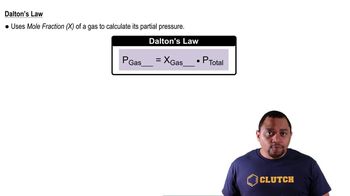
Use the mole fraction of each gas to determine its partial pressure. The partial pressure of a gas is given by \( P_i = X_i \times P_{\text{total}} \), where \( X_i \) is the mole fraction of the gas.
Look up or calculate the mole fractions of CO₂ and Ar from Table 18.1. If the table provides mole fractions, use them directly. If it provides percentages, convert them to mole fractions by dividing by 100.
Calculate the partial pressures: \( P_{\text{CO}_2} = X_{\text{CO}_2} \times 1.05 \text{ bar} \) and \( P_{\text{Ar}} = X_{\text{Ar}} \times 1.05 \text{ bar} \).

Risposta video verificata per un problema simile:
Questa soluzione video è stata consigliata dai nostri tutor come utile per risolvere questo problema.
Durata del video:
2mConcetti chiave
Ecco i concetti essenziali che devi comprendere per rispondere correttamente alla domanda.
Dalton's Law of Partial Pressures
Dalton's Law states that in a mixture of gases, the total pressure exerted is equal to the sum of the partial pressures of each individual gas. This principle allows us to calculate the pressure of a specific gas in a mixture by knowing the total pressure and the mole fraction of that gas.
Video consigliato:
Percorso guidato
Dalton's Law and Partial Pressure
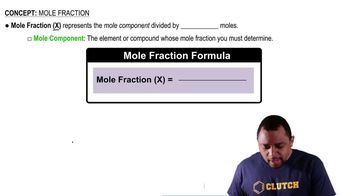
Mole Fraction
The mole fraction is a way of expressing the concentration of a component in a mixture. It is defined as the ratio of the number of moles of a specific gas to the total number of moles of all gases in the mixture. This value is crucial for calculating the partial pressure of each gas using Dalton's Law.
Video consigliato:
Percorso guidato
Mole Fraction Formula
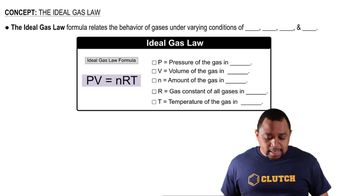
Ideal Gas Law
The Ideal Gas Law relates the pressure, volume, temperature, and number of moles of a gas through the equation PV = nRT. While this law is not directly used for calculating partial pressures, it provides a foundational understanding of gas behavior and can help in determining the number of moles needed for calculating mole fractions.
Video consigliato:
Percorso guidato
Ideal Gas Law Formula
Pratica correlata
Domanda del libro di testo
1063
views
Domanda del libro di testo
The dissociation energy of a carbon-bromine bond is typically about 276 kJ/mol. (a) What is the maximum wavelength of photons that can cause C-Br bond dissociation?
1346
views
Domanda del libro di testo
Air pollution in the Mexico City metropolitan area is among the worst in the world. The concentration of ozone in Mexico City has been measured at 441 ppb (0.441 ppm). Mexico City sits at an altitude of 7400 feet, which means its atmospheric pressure is only 0.67 atm. (b) How many ozone molecules are in 1.0 L of air in Mexico City? Assume T = 25 °C.
1175
views
Domanda del libro di testo
(b) Explain why the stratosphere, which is about 35 km thick, has a smaller total mass than the troposphere, which is about 12 km thick.
318
views
