Suppose that on another planet the atmosphere consists of 17% Kr, 38% CH4, and 45% O2. What is the average molar mass at the surface? What is the average molar mass at an altitude at which all the O2 is photodissociated?
Ch.18 - Chemistry of the Environment
Brown14th EditionChemistry: The Central ScienceISBN: 9780134414232Non è quello che usi tu?Cambia libro di testo
Capitolo 18, Problema 60
In the following three instances, which choice is greener in a chemical process? Explain. (a) A reaction that can be run at 350 K for 12 h without a catalyst or one that can be run at 300 K for 1 h with a reusable catalyst.
Guida verificata passo dopo passo1
Identify the key factors that determine the 'greenness' of a chemical process, such as energy consumption, time efficiency, and catalyst use.
Compare the energy requirements for both reactions. Consider that running a reaction at a lower temperature (300 K) generally consumes less energy than at a higher temperature (350 K).
Evaluate the time efficiency of both reactions. A reaction that completes in 1 hour is more time-efficient than one that takes 12 hours.
Consider the use of a catalyst. A reusable catalyst is beneficial as it can lower the activation energy, increase reaction rate, and be used multiple times, reducing waste.
Conclude that the reaction at 300 K for 1 hour with a reusable catalyst is likely greener due to lower energy consumption, increased time efficiency, and the sustainable use of a catalyst.

Risposta video verificata per un problema simile:
Questa soluzione video è stata consigliata dai nostri tutor come utile per risolvere questo problema.
Durata del video:
1mConcetti chiave
Ecco i concetti essenziali che devi comprendere per rispondere correttamente alla domanda.
Green Chemistry Principles
Green chemistry focuses on designing chemical processes that minimize waste and reduce the use of hazardous substances. It emphasizes sustainability and efficiency, aiming to create products and processes that are environmentally friendly. Understanding these principles helps evaluate the environmental impact of different chemical reactions.
Video consigliato:
Percorso guidato
Uncertainty Principle Formula
Catalysis
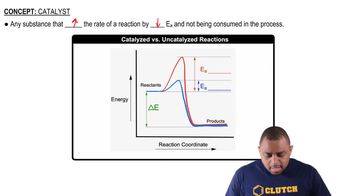
Catalysis involves the use of a substance (catalyst) that increases the rate of a chemical reaction without being consumed in the process. Catalysts can significantly lower the energy required for reactions, allowing them to occur under milder conditions. The use of reusable catalysts is particularly important in green chemistry as it reduces waste and resource consumption.
Video consigliato:
Percorso guidato
Catalyzed vs. Uncatalyzed Reactions
Temperature and Reaction Time
The temperature at which a reaction occurs can influence its rate and the energy required for the reaction. Generally, higher temperatures can increase reaction rates but may also lead to greater energy consumption and potential side reactions. Evaluating the trade-off between temperature and reaction time is crucial for determining the overall efficiency and environmental impact of a chemical process.
Video consigliato:
Percorso guidato
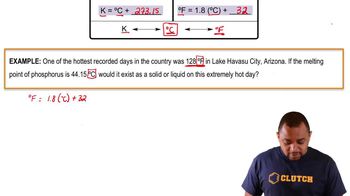
Temperature Conversion Example
Pratica correlata
Domanda del libro di testo
453
views
1
rank
Domanda del libro di testo
A reaction for converting ketones to lactones, called the Baeyer–Villiger reaction,
is used in the manufacture of plastics and pharmaceu- ticals. 3-Chloroperbenzoic acid is shock-sensitive, how- ever, and prone to explode. Also, 3-chlorobenzoic acid is a waste product. An alternative process being developed uses hydrogen peroxide and a catalyst consisting of tin deposited within a solid support. The catalyst is readily recovered from the reaction mixture. (a) What would you expect to be the other product of oxidation of the ketone to lactone by hydrogen peroxide?

729
views