Ch.18 - Chemistry of the Environment
Brown - Chemistry: The Central Science 14th Edition
Brown14th EditionChemistry: The Central ScienceISBN: 9780134414232Non è quello che usi tu?Cambia libro di testo
Capitolo 18, Problema 88

The degradation of CF3CH2F (an HFC) by OH radicals in the troposphere is first order in each reactant and has a rate constant of k = 1.6x10^8 M-1s-1 at 4 °C. If the tropospheric concentrations of OH and CF3CH2F are 8.1x10^5 and 6.3x10^8 molecules/cm3, respectively, what is the reaction rate at this temperature in M/s?

Guida verificata passo dopo passo
1
Convert the concentrations of OH and CF3CH2F from molecules/cm³ to molarity (M). Use the conversion factor: 1 mole = 6.022 x 10^23 molecules and 1 cm³ = 1 x 10^-3 L.
Calculate the molarity of OH by dividing the number of molecules by Avogadro's number and then converting cm³ to L.
Calculate the molarity of CF3CH2F using the same method as for OH.
Use the rate law for a second-order reaction: Rate = k[OH][CF3CH2F], where k is the rate constant and [OH] and [CF3CH2F] are the molar concentrations.
Substitute the values of k, [OH], and [CF3CH2F] into the rate equation to find the reaction rate in M/s.

Concetti chiave

Ecco i concetti essenziali che devi comprendere per rispondere correttamente alla domanda.

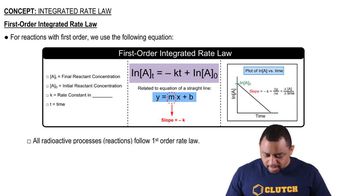
First-Order Reactions

First-order reactions are those where the rate of reaction is directly proportional to the concentration of one reactant. In this case, the degradation of CF3CH2F by OH radicals is first order in both reactants, meaning that the rate can be expressed as rate = k[OH][CF3CH2F], where k is the rate constant. Understanding this relationship is crucial for calculating the reaction rate.
Video consigliato:
Percorso guidato
02:29
First-Order Reactions

Rate Constant (k)

The rate constant (k) is a proportionality factor that relates the reaction rate to the concentrations of the reactants in a chemical reaction. It is specific to a given reaction at a particular temperature. In this question, the rate constant is given as 1.6x10^8 M-1s-1, which indicates how quickly the reaction occurs under the specified conditions.
Video consigliato:
Percorso guidato
01:14
Equilibrium Constant K

Concentration Units and Conversion

Concentration is often expressed in molarity (M), which is moles of solute per liter of solution. However, in this question, concentrations are provided in molecules per cubic centimeter (molecules/cm3). To calculate the reaction rate in M/s, it is necessary to convert these concentrations into molarity, using Avogadro's number (6.022x10^23 molecules/mol) to facilitate the conversion.
Video consigliato:
Percorso guidato
01:56
Conversion Factors