
Ch.18 - Chemistry of the Environment
Brown - Chemistry: The Central Science 14th Edition
Brown14th EditionChemistry: The Central ScienceISBN: 9780134414232Non è quello che usi tu?Cambia libro di testo
Capitolo 18, Problema 39b

The enthalpy of evaporation of water is 40.67 kJ/mol. Sunlight striking Earth's surface supplies 168 W per square meter (1 W = 1 watt = 1 J/s). (b) The specific heat capacity of liquid water is 4.184 J/g°C. If the initial surface temperature of a 1.00 square meter patch of ocean is 26 °C, what is its final temperature after being in sunlight for 12 h, assuming no phase changes and assuming that sunlight penetrates uniformly to depth of 10.0 cm?

Guida verificata passo dopo passo
1
Calculate the total energy supplied by sunlight over 12 hours. Use the formula: \( \text{Energy} = \text{Power} \times \text{Time} \). Convert 12 hours into seconds and multiply by the power per square meter (168 W/m²) to find the total energy in joules.
Determine the mass of the water being heated. Use the volume of water (1.00 m² area and 10.0 cm depth) to find the volume in cubic meters, then convert to liters (1 m³ = 1000 L). Since the density of water is approximately 1 g/mL, the mass in grams is numerically equal to the volume in milliliters.
Use the specific heat capacity formula to find the change in temperature: \( q = m \cdot c \cdot \Delta T \), where \( q \) is the energy calculated in step 1, \( m \) is the mass of the water, \( c \) is the specific heat capacity (4.184 J/g°C), and \( \Delta T \) is the change in temperature.
Rearrange the specific heat capacity formula to solve for the change in temperature: \( \Delta T = \frac{q}{m \cdot c} \). Substitute the values for \( q \), \( m \), and \( c \) to find \( \Delta T \).
Add the change in temperature \( \Delta T \) to the initial temperature (26 °C) to find the final temperature of the water after 12 hours of sunlight exposure.

Risposta video verificata per un problema simile:

Questa soluzione video è stata consigliata dai nostri tutor come utile per risolvere questo problema.
Durata del video:
10m

Concetti chiave

Ecco i concetti essenziali che devi comprendere per rispondere correttamente alla domanda.

Enthalpy of Evaporation

The enthalpy of evaporation, or heat of vaporization, is the amount of energy required to convert a unit mass of a liquid into vapor without a change in temperature. For water, this value is 40.67 kJ/mol, indicating that significant energy is needed to change water from liquid to gas. This concept is crucial for understanding energy transfer in processes involving water, especially in the context of temperature changes and phase transitions.
Video consigliato:
Percorso guidato
04:50
Filtration and Evaporation

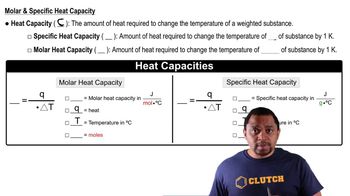
Specific Heat Capacity

Specific heat capacity is the amount of heat energy required to raise the temperature of a unit mass of a substance by one degree Celsius. For liquid water, this value is 4.184 J/g°C, which means it can absorb a considerable amount of heat before its temperature changes significantly. This property is essential for calculating temperature changes in water when exposed to heat sources, such as sunlight.
Video consigliato:

Energy Transfer from Sunlight

Energy transfer from sunlight can be quantified in terms of power, measured in watts (W), where 1 W equals 1 joule per second. In this scenario, sunlight provides 168 W/m², meaning that each square meter receives 168 joules of energy every second. Understanding this concept is vital for calculating the total energy absorbed by a given area over time, which directly influences the temperature change of the water.
Video consigliato:
Percorso guidato
00:40
Internal Energy