
Ch.18 - Chemistry of the Environment
Brown - Chemistry: The Central Science 14th Edition
Brown14th EditionChemistry: The Central ScienceISBN: 9780134414232Non è quello che usi tu?Cambia libro di testo
Capitolo 18, Problema 85

The main reason that distillation is a costly method for purifying water is the high energy required to heat and vaporize water. (a) Using the density, specific heat, and heat of vaporization of water from Appendix B, calculate the amount of energy required to vaporize 1.00 gal of water beginning with water at 20 °C. (b) If the energy is provided by electricity costing \$0.085/kWh, calculate its cost. (c) If distilled water sells in a grocery store for \$1.26 per gal, what percentage of the sales price is represented by the cost of the energy?

Guida verificata passo dopo passo
1
Step 1: Convert the volume of water from gallons to liters using the conversion factor 1 gallon = 3.78541 liters.
Step 2: Calculate the mass of the water using the density of water (approximately 1 g/mL or 1 kg/L) and the volume in liters.
Step 3: Calculate the energy required to heat the water from 20 °C to 100 °C using the formula q = mcΔT, where m is the mass of the water, c is the specific heat capacity of water (4.18 J/g°C), and ΔT is the temperature change.
Step 4: Calculate the energy required to vaporize the water at 100 °C using the formula q = mL, where m is the mass of the water and L is the heat of vaporization of water (2260 J/g).
Step 5: Add the energy calculated in steps 3 and 4 to find the total energy required, convert this energy from joules to kilowatt-hours (1 kWh = 3.6 x 10^6 J), and then calculate the cost using the given electricity rate of \$0.085/kWh. Finally, determine the percentage of the sales price represented by the energy cost by dividing the energy cost by the sales price and multiplying by 100.

Concetti chiave

Ecco i concetti essenziali che devi comprendere per rispondere correttamente alla domanda.

Heat of Vaporization

The heat of vaporization is the amount of energy required to convert a unit mass of a liquid into vapor without a change in temperature. For water, this value is significant because it indicates how much energy must be supplied to overcome intermolecular forces during the phase change from liquid to gas. Understanding this concept is crucial for calculating the energy needed to vaporize water in the distillation process.
Video consigliato:

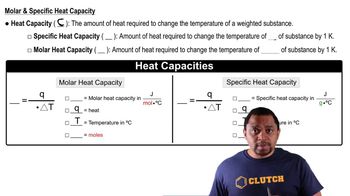
Specific Heat Capacity

Specific heat capacity is the amount of heat required to raise the temperature of a unit mass of a substance by one degree Celsius. For water, this value is relatively high, meaning it can absorb a lot of heat before its temperature changes significantly. This property is important in the context of heating water from an initial temperature (20 °C in this case) to its boiling point before vaporization occurs.
Video consigliato:

Cost of Energy Calculation

Calculating the cost of energy involves determining the total energy consumed and converting that into a monetary value based on the cost per kilowatt-hour (kWh). In this scenario, after calculating the energy required to vaporize the water, one must convert that energy from joules to kilowatt-hours and then multiply by the cost of electricity to find the total cost. This concept is essential for understanding the economic implications of using distillation for water purification.
Video consigliato:
Percorso guidato
01:51
Gibbs Free Energy of Reactions