
Ch.18 - Chemistry of the Environment
Brown - Chemistry: The Central Science 14th Edition
Brown14th EditionChemistry: The Central ScienceISBN: 9780134414232Non è quello che usi tu?Cambia libro di testo
Capitolo 18, Problema 22b

The ultraviolet spectrum can be divided into three regions based on wavelength: UV-A (315–400 nm), UV-B (280–315 nm), and UV-C (100–280 nm). (b) In the absence of ozone, which of these three regions, if any, are absorbed by the atmo- sphere?

Guida verificata passo dopo passo
1
Step 1: Understand the problem. The question is asking which of the three regions of the ultraviolet spectrum (UV-A, UV-B, and UV-C) are absorbed by the atmosphere in the absence of ozone.
Step 2: Recall that the Earth's atmosphere is composed of several layers, each with its own unique properties and functions. The ozone layer, which is located in the stratosphere, is primarily responsible for absorbing most of the Sun's harmful ultraviolet radiation.
Step 3: Understand that in the absence of ozone, the atmosphere would still absorb some UV radiation, but not as effectively. The atmosphere is composed of other gases such as nitrogen and oxygen, which can absorb some UV radiation, particularly in the UV-C region.
Step 4: Note that UV-A and UV-B are less effectively absorbed by the other gases in the atmosphere. Therefore, in the absence of ozone, more UV-A and UV-B would reach the Earth's surface.
Step 5: Conclude that in the absence of ozone, the UV-C region would still be absorbed by the atmosphere, while the UV-A and UV-B regions would be less effectively absorbed.

Risposta video verificata per un problema simile:

Questa soluzione video è stata consigliata dai nostri tutor come utile per risolvere questo problema.
Durata del video:
1m

Concetti chiave

Ecco i concetti essenziali che devi comprendere per rispondere correttamente alla domanda.

Ultraviolet Spectrum

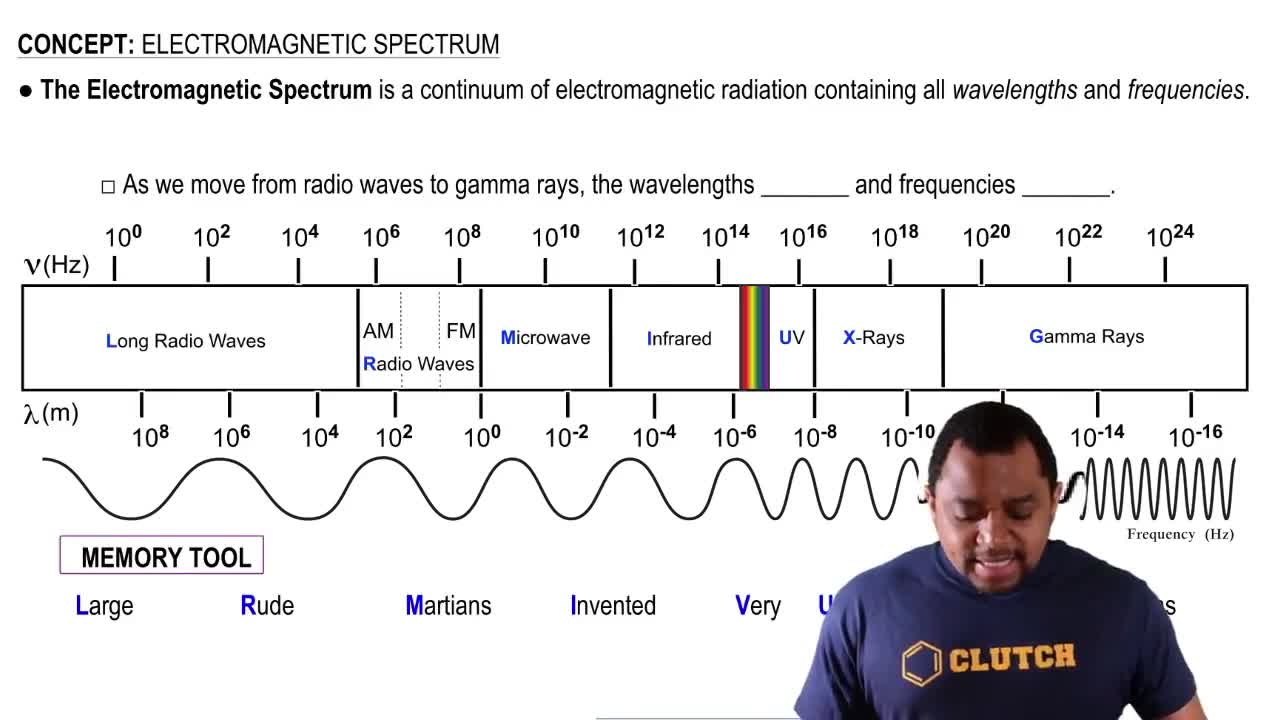
The ultraviolet (UV) spectrum is a portion of the electromagnetic spectrum with wavelengths shorter than visible light, ranging from about 10 nm to 400 nm. It is divided into three regions: UV-A (315–400 nm), UV-B (280–315 nm), and UV-C (100–280 nm), each with different properties and biological effects. Understanding these regions is crucial for assessing their interaction with the atmosphere and their potential impact on living organisms.
Video consigliato:
Percorso guidato
02:53
Electromagnetic Spectrum

Ozone Layer

The ozone layer is a region of Earth's stratosphere that contains a high concentration of ozone (O3) molecules, which absorb the majority of the sun's harmful UV radiation, particularly UV-B and UV-C. This protective layer plays a vital role in shielding the Earth's surface from excessive UV exposure, which can lead to skin cancer and other health issues. In the absence of ozone, the atmosphere's ability to filter UV radiation is significantly reduced.
Video consigliato:
Percorso guidato
08:52
Acid-Base Extraction

Atmospheric Absorption

Atmospheric absorption refers to the process by which certain gases and particles in the atmosphere absorb specific wavelengths of electromagnetic radiation. In the context of UV radiation, gases like ozone and water vapor absorb UV-B and UV-C radiation effectively, while UV-A is less absorbed. This concept is essential for understanding which regions of the UV spectrum reach the Earth's surface and the implications for environmental and health effects.
Video consigliato:
Percorso guidato
03:29
Electronic Transitions