Consider the following equilibrium: N2O4(g) ⇌ 2 NO2(g) Thermodynamic data on these gases are given in Appendix C. You may assume that ΔH° and ΔS° do not vary with temperature. (a) At what temperature will an equilibrium mixture contain equal amounts of the two gases?
Guida verificata passo dopo passo
1
Identify the expression for the equilibrium constant, K, for the reaction: N2O4(g) ⇌ 2 NO2(g). The equilibrium constant can be expressed as K = [NO2]2 / [N2O4].
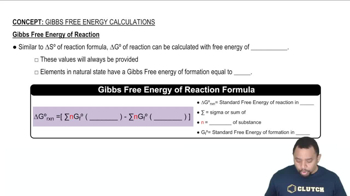
Set up the equation for the Gibbs free energy change (ΔG°) in terms of the standard enthalpy change (ΔH°) and the standard entropy change (ΔS°) at temperature T: ΔG° = ΔH° - TΔS°.
Relate ΔG° to the equilibrium constant K using the relationship ΔG° = -RT ln(K), where R is the gas constant and T is the temperature in Kelvin.
Combine the equations from steps 2 and 3 to solve for T when K = 1 (since at K = 1, the concentrations of N2O4 and NO2 are equal). This gives the equation: ΔH° - TΔS° = -RT ln(1). Since ln(1) = 0, simplify to ΔH° = TΔS°.
Solve for T by rearranging the equation from step 4: T = ΔH° / ΔS°. Use the values of ΔH° and ΔS° from the thermodynamic data provided in Appendix C to find the temperature at which the equilibrium mixture contains equal amounts of N2O4 and NO2.
Risposta video verificata per un problema simile:
Questa soluzione video è stata consigliata dai nostri tutor come utile per risolvere questo problema.
Durata del video:
4m
Guarda un video:
0 Commenti
Concetti chiave
Ecco i concetti essenziali che devi comprendere per rispondere correttamente alla domanda.
Chemical Equilibrium
Chemical equilibrium occurs when the rates of the forward and reverse reactions are equal, resulting in constant concentrations of reactants and products. In this case, the equilibrium expression can be used to relate the concentrations of N2O4 and NO2 at a given temperature, allowing for the determination of conditions under which equal amounts of both gases are present.
Gibbs Free Energy (G) is a thermodynamic potential that helps predict the direction of chemical reactions and the position of equilibrium. The change in Gibbs Free Energy (ΔG) is related to the enthalpy (ΔH) and entropy (ΔS) of the system, and at equilibrium, ΔG equals zero. This relationship is crucial for determining the temperature at which equal concentrations of N2O4 and NO2 exist.
The Van 't Hoff equation relates the change in the equilibrium constant (K) of a reaction to the change in temperature. It is expressed as ln(K2/K1) = -ΔH°/R(1/T2 - 1/T1), where R is the gas constant. This equation is essential for calculating the temperature at which the equilibrium concentrations of N2O4 and NO2 are equal, as it allows for the determination of K at different temperatures.


 Guida verificata passo dopo passo
 04:21
04:21