Methanol (CH3OH) can be made by the controlled oxidation of methane: CH4(g) + 12 O2(g) → CH3OH(g) (b) Will ΔG for the reaction increase, decrease, or stay unchanged with increasing temperature?
Ch.19 - Chemical Thermodynamics
Brown14th EditionChemistry: The Central ScienceISBN: 9780134414232Non è quello che usi tu?Cambia libro di testo
Capitolo 19, Problema 69b
Consider the following reaction between oxides of nitrogen: NO2(g) + N2O(g) → 3 NO(g) (b) Calculate ΔG at 800 K, assuming that ΔH° and ΔS° do not change with temperature. Under standard conditions is the reaction spontaneous at 800 K?
Guida verificata passo dopo passo1
Identify the given values: \( \Delta H^\circ \) (standard enthalpy change) and \( \Delta S^\circ \) (standard entropy change) for the reaction. These values are typically found in thermodynamic tables.
Use the Gibbs free energy equation: \( \Delta G = \Delta H - T \Delta S \), where \( T \) is the temperature in Kelvin. Substitute the given temperature (800 K) into the equation.
Calculate \( \Delta G \) using the values of \( \Delta H^\circ \) and \( \Delta S^\circ \) along with the temperature. Remember to convert \( \Delta S^\circ \) from J/mol·K to kJ/mol·K if necessary, to match the units of \( \Delta H^\circ \).
Determine the spontaneity of the reaction by analyzing the sign of \( \Delta G \). If \( \Delta G < 0 \), the reaction is spontaneous under standard conditions at 800 K. If \( \Delta G > 0 \), the reaction is non-spontaneous.
Conclude whether the reaction is spontaneous at 800 K under standard conditions based on the calculated \( \Delta G \).

Risposta video verificata per un problema simile:
Questa soluzione video è stata consigliata dai nostri tutor come utile per risolvere questo problema.
Durata del video:
10mConcetti chiave
Ecco i concetti essenziali che devi comprendere per rispondere correttamente alla domanda.
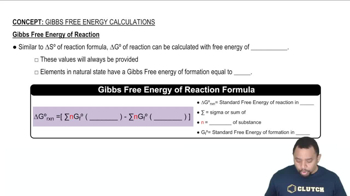
Gibbs Free Energy (ΔG)
Gibbs Free Energy (ΔG) is a thermodynamic potential that measures the maximum reversible work obtainable from a thermodynamic system at constant temperature and pressure. It is calculated using the equation ΔG = ΔH - TΔS, where ΔH is the change in enthalpy, T is the temperature in Kelvin, and ΔS is the change in entropy. A negative ΔG indicates that a reaction is spontaneous under the given conditions.
Video consigliato:
Percorso guidato
Gibbs Free Energy of Reactions
Enthalpy (ΔH) and Entropy (ΔS)
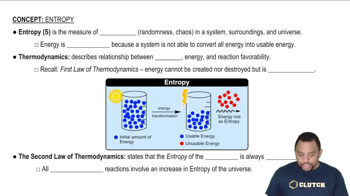
Enthalpy (ΔH) is the total heat content of a system, reflecting the energy required to break and form bonds during a reaction. Entropy (ΔS) measures the degree of disorder or randomness in a system. Both ΔH and ΔS are crucial for determining the spontaneity of a reaction through their influence on ΔG, particularly at varying temperatures.
Video consigliato:
Percorso guidato
Entropy in Thermodynamics
Spontaneity of Reactions
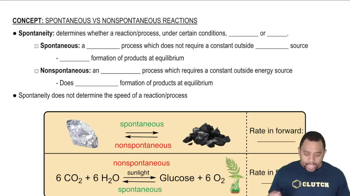
The spontaneity of a reaction refers to whether a reaction can occur without external intervention. A reaction is spontaneous if ΔG is negative, indicating that the products are favored at equilibrium. Factors such as temperature, enthalpy, and entropy changes play significant roles in determining spontaneity, especially in reactions involving gases and temperature variations.
Video consigliato:
Percorso guidato
Spontaneity of Processes
Pratica correlata
Domanda del libro di testo
670
views
Domanda del libro di testo
Consider the following reaction between oxides of nitrogen: NO2(g) + N2O(g) → 3 NO(g) (c) Calculate ΔG at 1000 K. Is the reaction spontaneous under standard conditions at this temperature?
334
views
Domanda del libro di testo
Reactions in which a substance decomposes by losing CO are called decarbonylation reactions. The decarbonylation of acetic acid proceeds according to: CH3COOH(l) → CH3OH(g) + CO(g) By using data from Appendix C, calculate the minimum temperature at which this process will be spontaneous under standard conditions. Assume that ΔH° and ΔS° do not vary with temperature.
806
views
Domanda del libro di testo
Consider the following reaction between oxides of nitrogen: NO2(g) + N2O(g) → 3 NO(g) (a) Use data in Appendix C to predict how ΔG for the reaction varies with increasing temperature.
516
views