


Ch.19 - Chemical Thermodynamics
Brown - Chemistry: The Central Science 14th Edition
Brown14th EditionChemistry: The Central ScienceISBN: 9780134414232Non è quello che usi tu?Cambia libro di testo
Capitolo 19, Problema 88

For each of the following processes, indicate whether the signs of ΔS and ΔH are expected to be positive, negative, or about zero. (a) A solid sublimes. (b) The temperature of a sample of Co(s) is lowered from 60 °C to 25 °C. (c) Ethyl alcohol evaporates from a beaker. (d) A diatomic molecule dissociates into atoms. (e) A piece of charcoal is combusted to form CO2(g) and H2O(g).

Guida verificata passo dopo passo
1
Identify the reactants and products in the combustion of charcoal. Charcoal is primarily carbon, so the reaction is C(s) + O_2(g) -> CO_2(g) + H_2O(g).
Consider the change in entropy (ΔS). Combustion typically involves a solid reactant forming gaseous products, which increases disorder. Therefore, ΔS is expected to be positive.
Consider the change in enthalpy (ΔH). Combustion reactions are exothermic, meaning they release heat. Therefore, ΔH is expected to be negative.
Summarize the expected signs: ΔS is positive due to increased disorder from solid to gas, and ΔH is negative due to the exothermic nature of combustion.
Reflect on the implications: The positive ΔS and negative ΔH indicate that the combustion of charcoal is both entropically and enthalpically favorable.

Risposta video verificata per un problema simile:

Questa soluzione video è stata consigliata dai nostri tutor come utile per risolvere questo problema.
Durata del video:
2m

Concetti chiave

Ecco i concetti essenziali che devi comprendere per rispondere correttamente alla domanda.

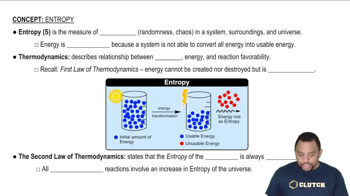
Entropy (ΔS)

Entropy, represented as ΔS, is a measure of the disorder or randomness in a system. In a combustion reaction, such as the burning of charcoal, the products (gaseous CO2 and H2O) have greater molecular freedom compared to the solid charcoal, leading to an increase in disorder. Therefore, ΔS is expected to be positive.
Video consigliato:
Percorso guidato
02:46
Entropy in Thermodynamics

Enthalpy (ΔH)

Enthalpy, denoted as ΔH, reflects the heat content of a system at constant pressure. Combustion reactions are typically exothermic, meaning they release heat as chemical bonds are broken and formed. In the case of charcoal combustion, the reaction releases energy, resulting in a negative ΔH.
Video consigliato:
Percorso guidato
02:34
Enthalpy of Formation

Gibbs Free Energy (ΔG)

Gibbs Free Energy, represented as ΔG, determines the spontaneity of a reaction and is calculated using the equation ΔG = ΔH - TΔS. For a reaction to be spontaneous, ΔG must be negative. In the combustion of charcoal, the combination of a negative ΔH and a positive ΔS suggests that ΔG will be negative, indicating that the reaction occurs spontaneously.
Video consigliato:
Percorso guidato
01:51
Gibbs Free Energy of Reactions