
Ch.19 - Chemical Thermodynamics
Brown - Chemistry: The Central Science 14th Edition
Brown14th EditionChemistry: The Central ScienceISBN: 9780134414232Non è quello che usi tu?Cambia libro di testo
Capitolo 19, Problema 29b

For the isothermal expansion of a gas into a vacuum, ΔE = 0, q = 0, and w = 0. (b) Explain why no work is done by the system during this process.

Guida verificata passo dopo passo
1
insert step 1> Understand the concept of isothermal expansion into a vacuum, which is also known as free expansion.
insert step 2> Recognize that in a vacuum, there is no external pressure opposing the expansion of the gas.
insert step 3> Recall that work done by a gas during expansion is given by the formula: w = -P_{ext} \(\Delta\) V, where P_{ext} is the external pressure.
insert step 4> Since the gas is expanding into a vacuum, P_{ext} = 0, meaning there is no opposing force.
insert step 5> Conclude that with P_{ext} = 0, the work done, w, is also 0, as w = -0 \(\times\) \(\Delta\) V = 0.

Risposta video verificata per un problema simile:

Questa soluzione video è stata consigliata dai nostri tutor come utile per risolvere questo problema.
Durata del video:
2m

Concetti chiave

Ecco i concetti essenziali che devi comprendere per rispondere correttamente alla domanda.

Isothermal Process

An isothermal process occurs at a constant temperature, meaning that the internal energy of an ideal gas remains unchanged during the expansion or compression. In this scenario, since the temperature is constant, any heat added to the system is used to do work, but in the case of expansion into a vacuum, there is no heat exchange with the surroundings.
Video consigliato:
Percorso guidato
04:20
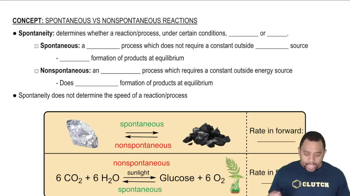
Spontaneity of Processes

Work in Thermodynamics

In thermodynamics, work is defined as the energy transfer that occurs when a force is applied over a distance. For a gas expanding against an external pressure, work is done by the system. However, in an expansion into a vacuum, there is no opposing pressure, meaning the gas does not push against anything, resulting in zero work done.
Video consigliato:
Percorso guidato
01:18
First Law of Thermodynamics

First Law of Thermodynamics

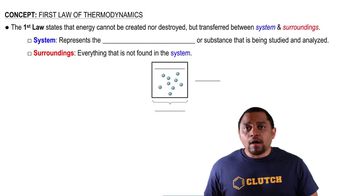
The First Law of Thermodynamics states that energy cannot be created or destroyed, only transformed. In the case of the isothermal expansion into a vacuum, the change in internal energy (ΔE) is zero, indicating that the energy remains constant. Since no work is done and no heat is exchanged, the system's energy balance confirms that ΔE = q + w = 0.
Video consigliato:
Percorso guidato
01:18
First Law of Thermodynamics