
Ch.19 - Chemical Thermodynamics
Brown - Chemistry: The Central Science 14th Edition
Brown14th EditionChemistry: The Central ScienceISBN: 9780134414232Non è quello che usi tu?Cambia libro di testo
Capitolo 19, Problema 41a

Predict the sign of the entropy change of the system for each of the following reactions: (a) N2(g) + 3 H2(g) → 2 NH3(g)

Guida verificata passo dopo passo
1
Identify the states of matter for the reactants and products. In this reaction, all species are gases.
Count the number of moles of gaseous reactants and products. For the reactants, there are 1 mole of N_2 and 3 moles of H_2, totaling 4 moles. For the products, there are 2 moles of NH_3.
Compare the total number of moles of gas on the reactant side to the product side. The reactant side has 4 moles of gas, while the product side has 2 moles of gas.
Recall that entropy (S) is a measure of disorder or randomness. A decrease in the number of moles of gas typically indicates a decrease in entropy, as gases have higher entropy than liquids or solids due to their greater freedom of movement.
Predict the sign of the entropy change (ΔS) for the system. Since the number of moles of gas decreases from reactants to products, the entropy change is likely negative (ΔS < 0).

Risposta video verificata per un problema simile:

Questa soluzione video è stata consigliata dai nostri tutor come utile per risolvere questo problema.
Durata del video:
1m

Concetti chiave

Ecco i concetti essenziali che devi comprendere per rispondere correttamente alla domanda.

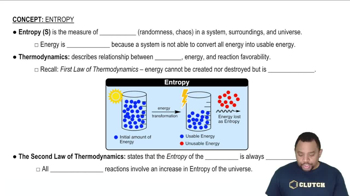
Entropy (S)

Entropy is a measure of the disorder or randomness in a system. In thermodynamics, it quantifies the number of ways a system can be arranged, with higher entropy indicating greater disorder. Understanding entropy is crucial for predicting the spontaneity of reactions and the direction of energy flow.
Video consigliato:
Percorso guidato
02:46
Entropy in Thermodynamics

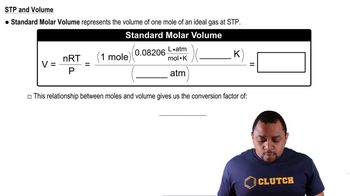
Gaseous Reactions and Molar Volume

In reactions involving gases, the number of moles of gas can significantly affect entropy. When the number of gas molecules decreases, as in the reaction N2(g) + 3 H2(g) → 2 NH3(g), the system becomes more ordered, typically resulting in a negative change in entropy. This concept is essential for analyzing the entropy change in gaseous reactions.
Video consigliato:
Percorso guidato
01:21
Standard Molar Volume

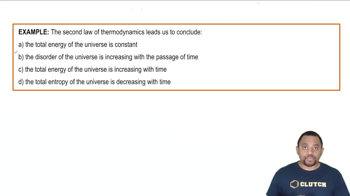
Second Law of Thermodynamics

The Second Law of Thermodynamics states that the total entropy of an isolated system can never decrease over time. It implies that spontaneous processes increase the overall entropy of the universe. This principle helps in predicting whether a reaction will occur spontaneously based on the sign of the entropy change associated with the reaction.
Video consigliato:
Percorso guidato
00:48
Second Law of Thermodynamics Example