Ch.19 - Chemical Thermodynamics
Brown - Chemistry: The Central Science 14th Edition
Brown14th EditionChemistry: The Central ScienceISBN: 9780134414232Non è quello che usi tu?Cambia libro di testo
Capitolo 19, Problema 41b

Predict the sign of the entropy change of the system for each of the following reactions: (b) CaCO3(s) → CaO(s) + CO2(g)

Guida verificata passo dopo passo
1
Identify the states of matter for each substance in the reaction: CaCO_3(s) is a solid, CaO(s) is a solid, and CO_2(g) is a gas.
Recognize that entropy, which is a measure of disorder or randomness, generally increases when a reaction produces more gas molecules.
Note that the reaction starts with one solid reactant and produces one solid and one gaseous product.
Understand that the production of a gas from a solid typically results in an increase in entropy because gases have higher entropy than solids.
Predict that the entropy change (ΔS) for the system is positive, as the formation of CO_2(g) increases the disorder of the system.

Risposta video verificata per un problema simile:

Questa soluzione video è stata consigliata dai nostri tutor come utile per risolvere questo problema.
Durata del video:
1m

Concetti chiave

Ecco i concetti essenziali che devi comprendere per rispondere correttamente alla domanda.

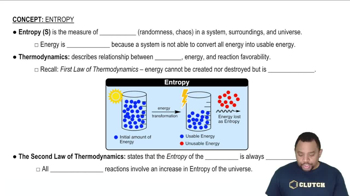
Entropy

Entropy is a measure of the disorder or randomness in a system. In thermodynamics, it quantifies the number of ways a system can be arranged, with higher entropy indicating greater disorder. Understanding entropy is crucial for predicting the spontaneity of reactions and the direction in which they proceed.
Video consigliato:
Percorso guidato
02:46
Entropy in Thermodynamics

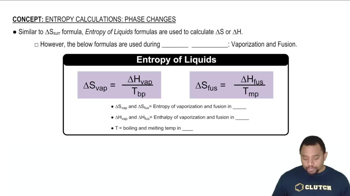
Phase Changes and Gaseous Products

The phase of a substance significantly affects its entropy. Gases have much higher entropy than solids due to their greater freedom of movement and higher number of microstates. In the reaction given, the formation of a gas (CO2) from a solid (CaCO3) suggests an increase in entropy, as the system transitions from a more ordered state to a less ordered one.
Video consigliato:
Percorso guidato
01:46
Entropy in Phase Changes

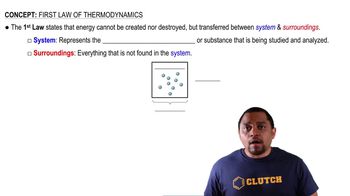
Thermodynamic Principles

Thermodynamic principles, particularly the second law, state that the total entropy of an isolated system can never decrease over time. This principle helps predict the sign of entropy changes in chemical reactions. In the reaction provided, the production of a gas from a solid indicates a positive change in entropy, aligning with the tendency for systems to evolve towards greater disorder.
Video consigliato:
Percorso guidato
01:18
First Law of Thermodynamics