

The fuel in high-efficiency natural-gas vehicles consists primarily of methane (CH4). (a) How much heat is produced in burning 1 mol of CH4(g) under standard conditions if reactants and products are brought to 298 K and H2O(l) is formed?
Ch.19 - Chemical Thermodynamics
Brown14th EditionChemistry: The Central ScienceISBN: 9780134414232Non è quello che usi tu?Cambia libro di testo
Capitolo 19, Problema 74b
The fuel in high-efficiency natural-gas vehicles consists primarily of methane (CH4). (b) What is the maximum amount of useful work that can be accomplished under standard conditions by this system?
Guida verificata passo dopo passo1
Identify the chemical reaction involved: The combustion of methane (CH4) in the presence of oxygen (O2) to produce carbon dioxide (CO2) and water (H2O). The balanced chemical equation is CH4 + 2O2 → CO2 + 2H2O.
Understand the concept of Gibbs free energy (ΔG), which is used to determine the maximum amount of non-expansion work that can be obtained from a chemical reaction at constant temperature and pressure. The equation for Gibbs free energy is ΔG = ΔH - TΔS, where ΔH is the change in enthalpy, T is the temperature in Kelvin, and ΔS is the change in entropy.
Look up standard enthalpy (ΔH°) and standard entropy (ΔS°) values for the reactants and products at 298 K (25°C). These values are typically found in thermodynamic tables.
Calculate the standard change in enthalpy (ΔH°) and the standard change in entropy (ΔS°) for the reaction using the formula: ΔH° = ΣH°(products) - ΣH°(reactants) and ΔS° = ΣS°(products) - ΣS°(reactants).
Substitute the values of ΔH°, ΔS°, and T (298 K) into the Gibbs free energy equation to find ΔG°, which represents the maximum amount of useful work under standard conditions.

Risposta video verificata per un problema simile:
Questa soluzione video è stata consigliata dai nostri tutor come utile per risolvere questo problema.
Durata del video:
3mConcetti chiave
Ecco i concetti essenziali che devi comprendere per rispondere correttamente alla domanda.
Gibbs Free Energy
Gibbs Free Energy (G) is a thermodynamic potential that measures the maximum reversible work obtainable from a thermodynamic system at constant temperature and pressure. It is crucial for determining the spontaneity of a reaction; a negative change in Gibbs Free Energy indicates that a process can perform useful work. In the context of methane combustion, calculating the Gibbs Free Energy change helps assess the maximum work output from the fuel.
Video consigliato:
Percorso guidato
Gibbs Free Energy of Reactions
Standard Conditions
Standard conditions refer to a set of specific conditions used as a reference point in thermodynamics, typically defined as 1 bar of pressure and a specified temperature, usually 25°C (298 K). These conditions allow for consistent comparisons of thermodynamic data, such as enthalpy and Gibbs Free Energy. Understanding standard conditions is essential for accurately calculating the maximum work from methane combustion.
Video consigliato:
Percorso guidato
Standard Reduction Potentials
Combustion Reaction
A combustion reaction is a chemical process in which a substance (usually a hydrocarbon like methane) reacts with oxygen to produce carbon dioxide, water, and energy. The stoichiometry of the reaction and the enthalpy change associated with it are vital for determining the energy released and the potential work that can be harnessed. In the case of methane, the complete combustion reaction is CH4 + 2O2 → CO2 + 2H2O, which releases significant energy.
Video consigliato:
Percorso guidato
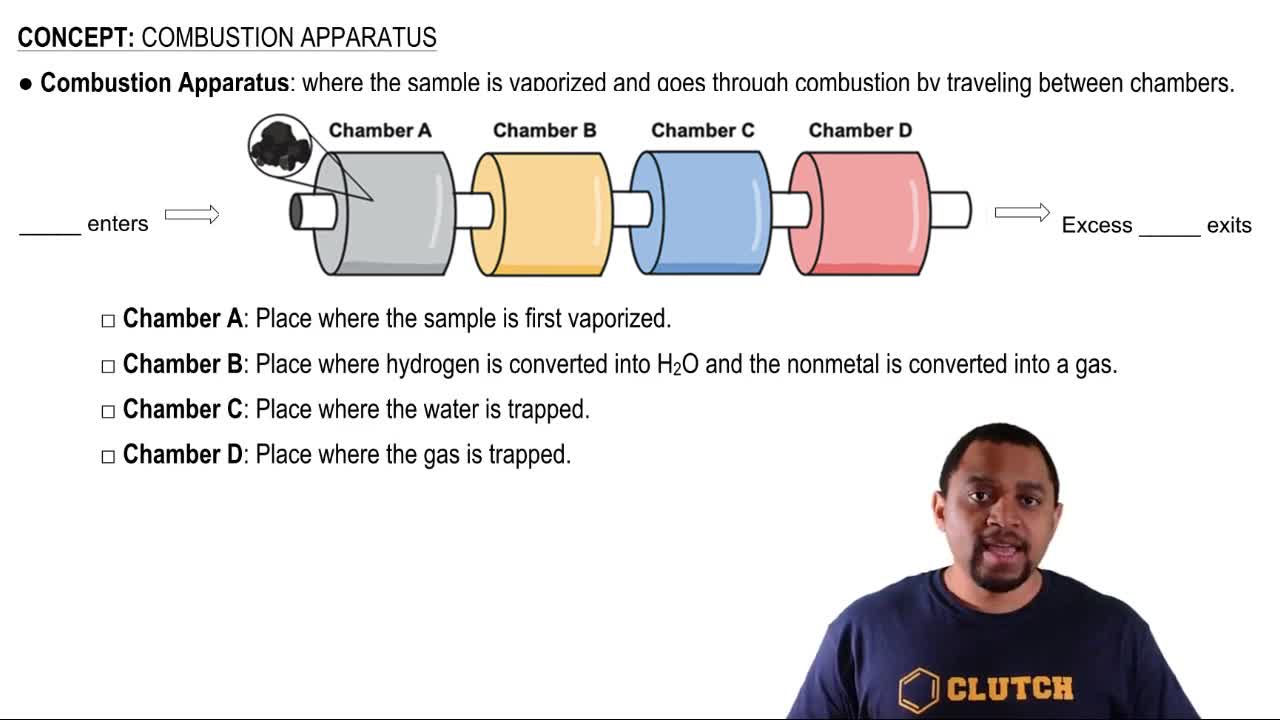
Combustion Apparatus
Pratica correlata
Domanda del libro di testo
528
views
Domanda del libro di testo
Consider the reaction 2 NO2(g) → N2O4(g). (a) Using data from Appendix C, calculate ΔG° at 298 K. (b) Calculate ΔG at 298 K if the partial pressures of NO2 and N2O4 are 0.40 atm and 1.60 atm, respectively.
843
views
Domanda del libro di testo
(a) Using data in Appendix C, estimate the temperature at which the free-energy change for the transformation from I2(s) to I2(g) is zero. (b) Use a reference source, such as Web Elements (www.webelements.com), to find the experimental melting and boiling points of I2. (c) Which of the values in part (b) is closer to the value you obtained in part (a)?
678
views
