Ch.19 - Chemical Thermodynamics
Brown - Chemistry: The Central Science 14th Edition
Brown14th EditionChemistry: The Central ScienceISBN: 9780134414232Non è quello che usi tu?Cambia libro di testo
Capitolo 19, Problema 99b

The oxidation of glucose (C6H12O6) in body tissue produces CO2 and H2O. In contrast, anaerobic decomposition, which occurs during fermentation, produces ethanol (C2H5OH) and CO2.
(b) Compare the maximum work that can be obtained from these processes under standard conditions.
C6H12O6(s) + 6 O2(g) ⇌ 6 CO2(g) + 6 H2O(l)
C6H12O6(s) ⇌ 2 C2H5OH(l) + 2 CO2(g)

Guida verificata passo dopo passo
1
1. The maximum work that can be obtained from a process is related to the change in Gibbs free energy (ΔG) for the process. The Gibbs free energy is a thermodynamic potential that measures the maximum reversible work that a system can perform at constant temperature and pressure. The formula for Gibbs free energy is ΔG = ΔH - TΔS, where ΔH is the change in enthalpy, T is the temperature in Kelvin, and ΔS is the change in entropy.
2. For the oxidation of glucose, the reaction is C6H12O6(s) + 6 O2(g) ⇌ 6 CO2(g) + 6 H2O(l). You would need to look up the standard enthalpies of formation (ΔHf) and standard entropies (S0) for each substance involved in the reaction. Then, calculate the ΔH and ΔS for the reaction using the formulas ΔH = ΣΔHf(products) - ΣΔHf(reactants) and ΔS = ΣS0(products) - ΣS0(reactants).
3. For the anaerobic decomposition of glucose, the reaction is C6H12O6(s) ⇌ 2 C2H5OH(l) + 2 CO2(g). Similarly, look up the standard enthalpies of formation and standard entropies for each substance involved in the reaction. Then, calculate the ΔH and ΔS for the reaction using the same formulas as in step 2.
4. Once you have the ΔH and ΔS for both reactions, you can calculate the ΔG for each reaction using the formula ΔG = ΔH - TΔS. Remember to convert the temperature to Kelvin if it is given in degrees Celsius.
5. Compare the ΔG values for the two reactions. The reaction with the more negative ΔG value can perform more work under standard conditions. This is because a negative ΔG indicates that the reaction is spontaneous, and the magnitude of ΔG indicates the maximum work that can be obtained from the process.

Risposta video verificata per un problema simile:

Questa soluzione video è stata consigliata dai nostri tutor come utile per risolvere questo problema.
Durata del video:
6m

Concetti chiave

Ecco i concetti essenziali che devi comprendere per rispondere correttamente alla domanda.

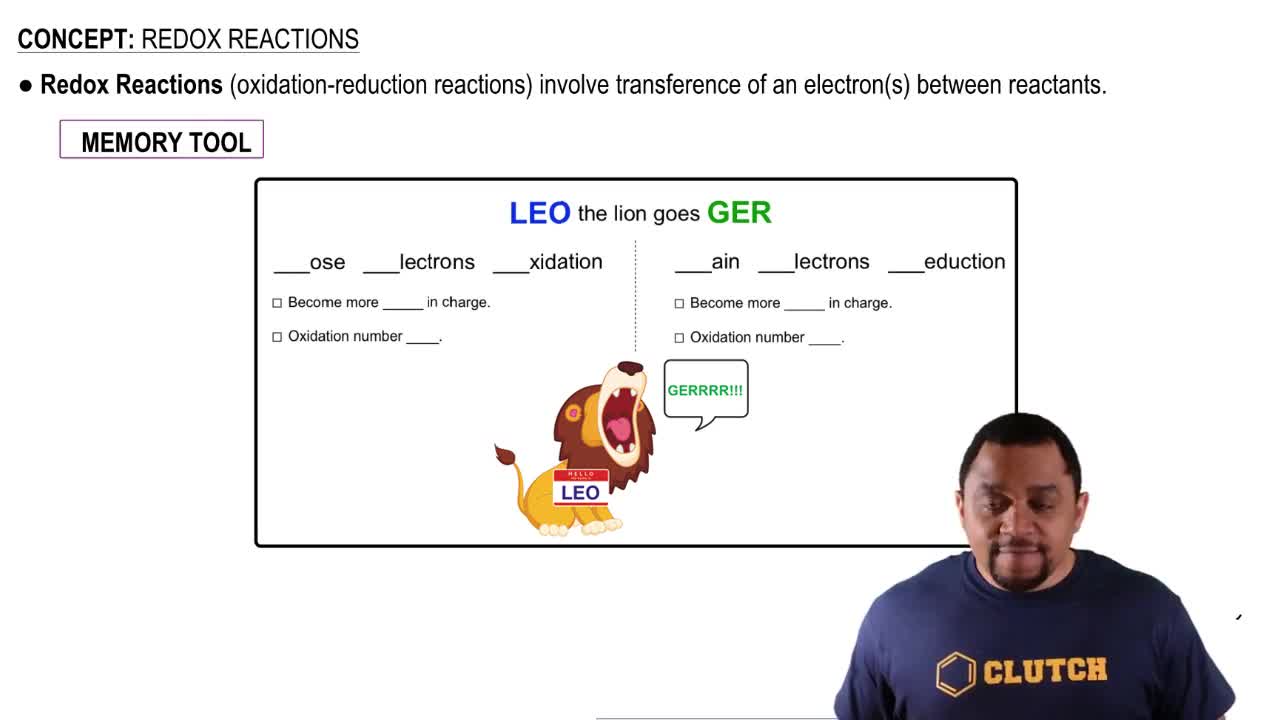
Oxidation and Reduction Reactions

Oxidation and reduction reactions, collectively known as redox reactions, involve the transfer of electrons between substances. In the context of glucose metabolism, glucose is oxidized to produce carbon dioxide and water, releasing energy. Understanding these reactions is crucial for comparing the energy yield of aerobic versus anaerobic processes.
Video consigliato:
Percorso guidato
01:53
Oxidation and Reduction Reactions

Standard Gibbs Free Energy Change (ΔG°)

The standard Gibbs free energy change (ΔG°) is a thermodynamic quantity that indicates the maximum reversible work obtainable from a process at standard conditions. It helps determine the spontaneity of a reaction; a negative ΔG° indicates that the reaction can occur spontaneously. This concept is essential for comparing the energy efficiency of glucose oxidation and fermentation.
Video consigliato:
Percorso guidato
00:32
Standard Gibbs Free Energy and Temperature

Cellular Respiration vs. Fermentation

Cellular respiration is an aerobic process that fully oxidizes glucose to carbon dioxide and water, yielding a high amount of ATP, while fermentation is an anaerobic process that partially breaks down glucose to produce ethanol and carbon dioxide, resulting in less ATP. Understanding the differences in energy production between these two pathways is key to evaluating their maximum work output.
Video consigliato:
Percorso guidato
03:05
Ksp vs Q in Precipitation
Pratica correlata
Domanda del libro di testo

(c) In each case, indicate whether K should increase or decrease with increasing temperature. (i) 2 Mg(s) + O2 (g) ⇌ 2 MgO(s) (ii) 2 KI(s) ⇌ 2 K(g) + I2(g) (iii) Na2(g) ⇌ 2 Na(g) (iv) 2 V2O5(s) ⇌ 4 V(s) + 5 O2(g)

Domanda del libro di testo

The potassium-ion concentration in blood plasma is about 5.0⨉10-3 M, whereas the concentration in muscle-cell fluid is much greater (0.15 M ). The plasma and intracellular fluid are separated by the cell membrane, which we assume is permeable only to K+. (a) What is ΔG for the transfer of 1 mol of K+ from blood plasma to the cellular fluid at body temperature 37 °C? (b) What is the minimum amount of work that must be used to transfer this K+?

1097
views
1
rank
Domanda del libro di testo

The oxidation of glucose (C6H12O6) in body tissue produces CO2 and H2O. In contrast, anaerobic decomposition, which occurs during fermentation, produces ethanol (C2H5OH) and CO2.

(a) Using data given in Appendix C, compare the equilibrium constants for the following reactions:

C6H12O6(s) + 6 O2(g) ⇌ 6 CO2(g) + 6 H2O(l)

C6H12O6(s) ⇌ 2 C2H5OH(l) + 2 CO2(g)

995
views
Domanda del libro di testo

The conversion of natural gas, which is mostly methane, into products that contain two or more carbon atoms, such as ethane (C2H6), is a very important industrial chemical process. In principle, methane can be converted into ethane and hydrogen: 2 CH4(g) → C2H6(g) + H2(g) In practice, this reaction is carried out in the presence of oxygen: 2 CH4(g) + 12 O2(g) → C2H6(g) + H2O(g) (b) Is the difference in ΔG° for the two reactions due primarily to the enthalpy term (ΔH) or the entropy term (-TΔS)?

407
views
Domanda del libro di testo

The conversion of natural gas, which is mostly methane, into products that contain two or more carbon atoms, such as ethane (C2H6), is a very important industrial chemical process. In principle, methane can be converted into ethane and hydrogen: 2 CH4(g) → C2H6(g) + H2(g) In practice, this reaction is carried out in the presence of oxygen: 2 CH4(g) + 1/2 O2(g) → C2H6(g) + H2O(g) (c) Explain how the preceding reactions are an example of driving a nonspontaneous reaction, as discussed in the 'Chemistry and Life' box in Section 19.7.

754
views