
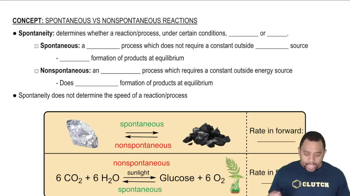

Indicate whether each statement is true or false. (a) A reaction that is spontaneous in one direction will be nonspontaneous in the reverse direction under the same reaction conditions. (b) All spontaneous processes are fast. (c) Most spontaneous processes are reversible. (d) An isothermal process is one in which the system loses no heat. (e) The maximum amount of work can be accomplished by an irreversible process rather than a reversible one.
Ch.19 - Chemical Thermodynamics
Brown14th EditionChemistry: The Central ScienceISBN: 9780134414232Non è quello che usi tu?Cambia libro di testo
Capitolo 19, Problema 12
Which of the following processes are spontaneous?
a. the melting of ice cubes at −10 °C and 1 atm pressure
b. separating a mixture of N2 and O2 into two separate samples, one that is pure N2 and one that is pure O2
c. alignment of iron filings in a magnetic field
d. the reaction of hydrogen gas with oxygen gas to form water vapor at room temperature
e. the dissolution of HCl(g) in water to form concentrated hydrochloric acid
Guida verificata passo dopo passo1
Step 1: Understand the concept of spontaneity in chemical processes. A spontaneous process is one that occurs naturally under given conditions without needing external energy input. It is often associated with an increase in entropy or a decrease in free energy.
Step 2: Analyze option (a): The melting of ice cubes at -10 °C and 1 atm pressure. Consider the phase change and the temperature. Ice melts spontaneously at temperatures above 0 °C, so at -10 °C, this process is not spontaneous.
Step 3: Analyze option (b): Separating a mixture of N2 and O2 into pure samples. This process decreases entropy because it involves creating order from disorder, which is not spontaneous without external work.
Step 4: Analyze option (c): Alignment of iron filings in a magnetic field. This process is spontaneous because the magnetic field provides the necessary energy to align the filings, and it occurs naturally when the filings are exposed to the field.
Step 5: Analyze option (d) and (e): The reaction of hydrogen gas with oxygen gas to form water vapor is spontaneous at room temperature due to the release of energy (exothermic reaction). The dissolution of HCl(g) in water is also spontaneous as it involves the release of energy and an increase in entropy.

Risposta video verificata per un problema simile:
Questa soluzione video è stata consigliata dai nostri tutor come utile per risolvere questo problema.
Durata del video:
1mConcetti chiave
Ecco i concetti essenziali che devi comprendere per rispondere correttamente alla domanda.
Spontaneity in Chemical Processes
A spontaneous process is one that occurs without the need for external energy input. It is driven by the increase in the system's entropy or the decrease in its Gibbs free energy. Understanding spontaneity helps predict whether a reaction or physical change will occur under given conditions.
Video consigliato:
Percorso guidato
Spontaneity of Processes
Entropy and Temperature
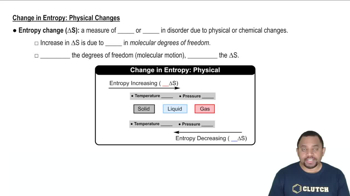
Entropy is a measure of the disorder or randomness in a system. As temperature increases, the entropy of a system typically increases, which can influence the spontaneity of processes. For example, the melting of ice at higher temperatures is spontaneous due to increased molecular motion and disorder.
Video consigliato:
Percorso guidato
Entropy and Physical Changes
Gibbs Free Energy
Gibbs free energy (G) combines enthalpy and entropy to determine the spontaneity of a process at constant temperature and pressure. A negative change in Gibbs free energy (ΔG < 0) indicates a spontaneous process, while a positive change (ΔG > 0) suggests non-spontaneity. This concept is crucial for evaluating chemical reactions and physical changes.
Video consigliato:
Percorso guidato
Gibbs Free Energy of Reactions
Pratica correlata
Domanda del libro di testo
931
views
Domanda del libro di testo
(d) Does the amount of work that a system can do on its surroundings depend on the path of the process?
617
views
Domanda del libro di testo
Which of the following processes are spontaneous and which are nonspontaneous: (d) lightning
944
views
1
rank
Domanda del libro di testo
Which of the following processes are spontaneous and which are nonspontaneous: (e) formation of CH4 and O2 molecules from CO2 and H2O at room temperature and 1 atm of pressure?
1390
views
Domanda del libro di testo
Which of the following processes are spontaneous and which are nonspontaneous: (a) the ripening of a banana
760
views
