
Ch.2 - Atoms, Molecules, and Ions
Brown - Chemistry: The Central Science 14th Edition
Brown14th EditionChemistry: The Central ScienceISBN: 9780134414232Non è quello che usi tu?Cambia libro di testo
Capitolo 2, Problema 11a

A 1.0-g sample of carbon dioxide (CO2) is fully decomposed into its elements, yielding 0.273 g of carbon and 0.727 g of oxygen. (a) What is the ratio of the mass of O to C?

Guida verificata passo dopo passo
1
Identify the masses of carbon and oxygen obtained from the decomposition: 0.273 g of carbon and 0.727 g of oxygen.
To find the ratio of the mass of oxygen to carbon, use the formula: \( \text{Ratio} = \frac{\text{mass of oxygen}}{\text{mass of carbon}} \).
Substitute the given masses into the formula: \( \text{Ratio} = \frac{0.727}{0.273} \).
Simplify the fraction to find the ratio of the mass of oxygen to carbon.
Express the ratio in its simplest form to understand the proportion of oxygen to carbon in the decomposed sample.

Risposta video verificata per un problema simile:

Questa soluzione video è stata consigliata dai nostri tutor come utile per risolvere questo problema.
Durata del video:
1m

Concetti chiave

Ecco i concetti essenziali che devi comprendere per rispondere correttamente alla domanda.

Mass Ratio

The mass ratio is a comparison of the mass of one substance to the mass of another. In this context, it refers to the ratio of the mass of oxygen to the mass of carbon in the decomposition of carbon dioxide. This ratio is calculated by dividing the mass of oxygen by the mass of carbon, providing insight into the relative amounts of each element in the compound.
Video consigliato:
Percorso guidato
02:14
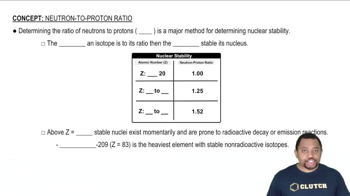
Neutron-Proton Ratio

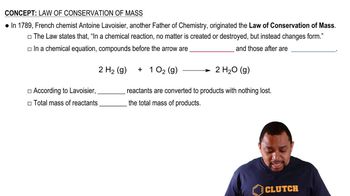
Law of Conservation of Mass

The Law of Conservation of Mass states that mass is neither created nor destroyed in a chemical reaction. This principle is crucial in understanding that the total mass of the products (carbon and oxygen) must equal the mass of the original compound (carbon dioxide). It ensures that when CO2 decomposes, the masses of the resulting elements can be accurately accounted for.
Video consigliato:
Percorso guidato
01:48
Law of Conservation of Mass

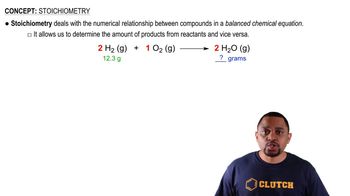
Stoichiometry

Stoichiometry is the branch of chemistry that deals with the quantitative relationships between the reactants and products in a chemical reaction. It allows chemists to predict the amounts of substances consumed and produced in a reaction. In this case, stoichiometry helps in understanding how the masses of carbon and oxygen relate to each other after the decomposition of CO2.
Video consigliato:
Percorso guidato
01:16
Stoichiometry Concept
Pratica correlata
Domanda del libro di testo

Sodium reacts with oxygen in air to form two compounds: sodium oxide and sodium peroxide. In forming sodium oxide, 23.0 g of sodium combines with 8.0 g of hydrogen. In forming sodium peroxide, 23.0 g of sodium combines with 16.0 g of oxygen. (a) What are the mass ratios of oxygen in the two compounds?

2
views
Domanda del libro di testo

Five of the boxes in the following periodic table are colored. Predict the charge on the ion associated with each of these elements.

355
views
Domanda del libro di testo

In the Millikan oil-drop experiment (see Figure 2.5), the tiny oil drops are observed through the viewing lens as rising, stationary, or falling, as shown here. (a) What causes their rate of fall to vary from their rate in the absence of an electric field?

422
views
Domanda del libro di testo

A 1.0-g sample of carbon dioxide (CO2) is fully decomposed into its elements, yielding 0.273 g of carbon and 0.727 g of oxygen. (b) If a sample of a different compound decomposes into 0.429 g of carbon and 0.571 g of oxygen, what is its ratio of the mass of O to C?

829
views
Domanda del libro di testo

A 1.0-g sample of carbon dioxide (CO2) is fully decomposed into its elements, yielding 0.273 g of carbon and 0.727 g of oxygen. If a sample of a different compound decomposes into 0.429 g of carbon and 0.571 g of oxygen, what is its ratio of the mass of O to C? (c) According to Dalton's atomic theory, what is the empirical formula of the second compound?

2001
views
Domanda del libro di testo

The following diagram represents an ionic compound in which the red spheres represent cations and the blue spheres represent anions. Which of the following formulas is consistent with the drawing? KBr, K2SO4, Ca1NO322, Fe21SO423.

636
views