Ch.2 - Atoms, Molecules, and Ions
Brown - Chemistry: The Central Science 14th Edition
Brown14th EditionChemistry: The Central ScienceISBN: 9780134414232Non è quello che usi tu?Cambia libro di testo
Capitolo 2, Problema 91b

(b) Using the mass of the proton from Table 2.1 and assuming its diameter is 1.0 * 10-15 m, calculate the density of a proton in g>cm3.

Guida verificata passo dopo passo
1
Identify the mass of a proton from Table 2.1, which is approximately 1.67 \(\times\) 10^{-27} \(\text{ kg}\).
Convert the mass of the proton from kilograms to grams by using the conversion factor: 1 \(\text{ kg}\) = 1000 \(\text{ g}\).
Assume the proton is spherical and use the formula for the volume of a sphere: V = \(\frac{4}{3}\) \(\pi\) r^3, where r is the radius of the proton.
Calculate the radius of the proton by dividing the given diameter (1.0 \(\times\) 10^{-15} \(\text{ m}\)) by 2.
Convert the volume from cubic meters to cubic centimeters using the conversion factor: 1 \(\text{ m}\)^3 = 10^6 \(\text{ cm}\)^3, and then calculate the density using the formula: \(\text{Density}\) = \(\frac{\text{mass}\)}{\(\text{volume}\)}.

Risposta video verificata per un problema simile:

Questa soluzione video è stata consigliata dai nostri tutor come utile per risolvere questo problema.
Durata del video:
5m

Concetti chiave

Ecco i concetti essenziali che devi comprendere per rispondere correttamente alla domanda.

Density

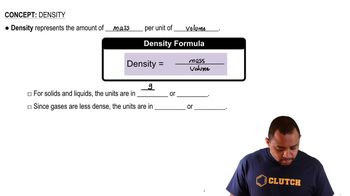
Density is defined as mass per unit volume, typically expressed in grams per cubic centimeter (g/cm³) in chemistry. It provides a measure of how much matter is contained in a given volume. To calculate density, one can use the formula: density = mass/volume. Understanding this concept is crucial for determining the density of a proton based on its mass and volume.
Video consigliato:
Percorso guidato
01:56
Density Concepts

Mass of a Proton

The mass of a proton is a fundamental constant in physics and chemistry, approximately 1.67 x 10^-24 grams. This value is essential for calculations involving atomic and molecular masses. In the context of the question, knowing the mass of the proton allows for the calculation of its density when combined with its volume.
Video consigliato:
Percorso guidato
02:14
Neutron-Proton Ratio

Volume of a Sphere

The volume of a sphere is calculated using the formula V = (4/3)πr³, where r is the radius. In this case, the diameter of the proton is given, so the radius can be determined by dividing the diameter by two. This volume is necessary to find the density of the proton, as it provides the space occupied by the mass of the proton.
Video consigliato:
Percorso guidato
02:35
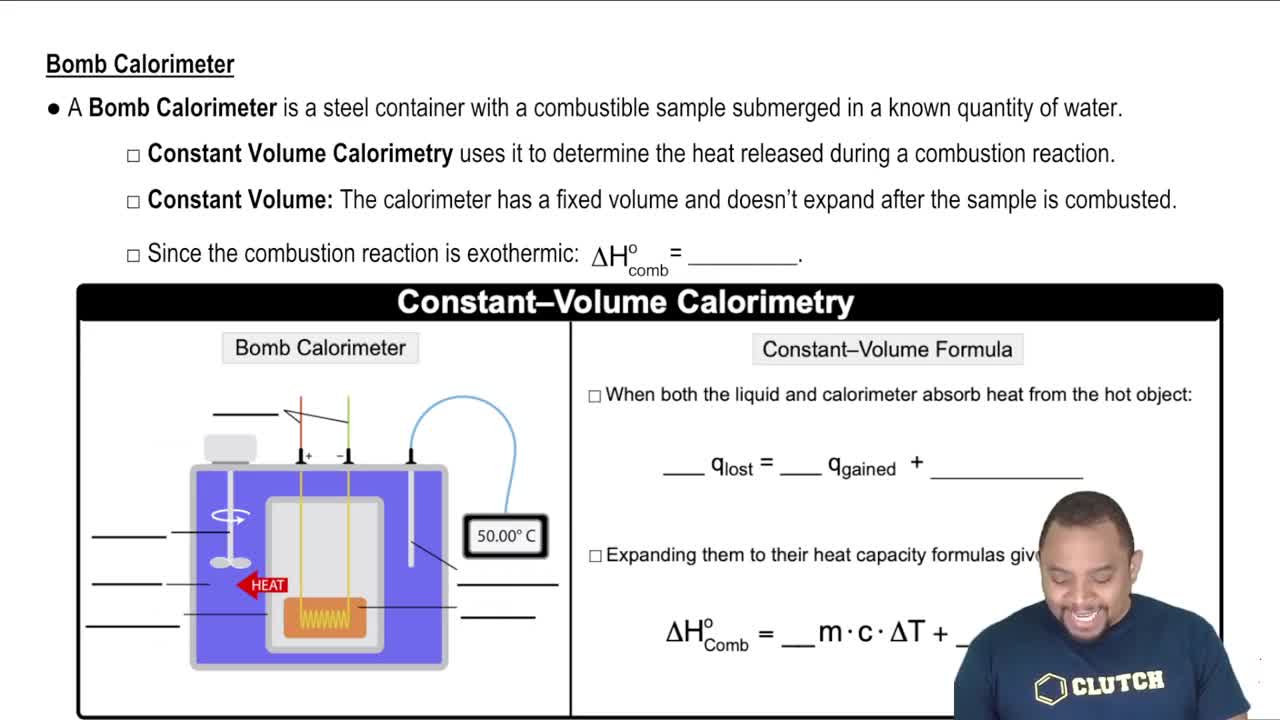
Constant-Volume Calorimetry
Pratica correlata
Domanda del libro di testo

Identify the element represented by each of the following symbols and give the number of protons and neutrons in each: (a) 7433X

830
views

Domanda del libro di testo

"The diameter of a rubidium atom is 495 pm We will consider two different ways of placing the atoms on a surface. In arrangement A, all the atoms are lined up with one another to form a square grid. Arrangement B is called a close-packed arrangement because the atoms sit in the 'depressions' formed by the previous row of atoms:

(c) If extended to three dimensions, which arrangement would lead to a greater density for Rb metal?"

806
views
Domanda del libro di testo

(a) Assuming the dimensions of the nucleus and atom shown in Figure 2.10, what fraction of the volume of the atom is taken up by the nucleus?

384
views
Domanda del libro di testo

The nucleus of 6Li is a powerful absorber of neutrons. It exists in the naturally occurring metal to the extent of 7.5%. In the era of nuclear deterrence, large quantities of lithium were processed to remove 6Li for use in hydrogen bomb production. The lithium metal remaining after removal of 6Li was sold on the market. (a) What are the compositions of the nuclei of 6Li and 7Li?

1
views
Domanda del libro di testo
Very small semiconductor crystals, composed of approximately 1000 to 10,000 atoms, are called quantum dots. Quantum dots made of the semiconductor CdSe are now being used in electronic reader and tablet displays because they emit light efficiently and in multiple colors, depending on dot size. The density of CdSe is 5.82 g/cm3. (b) CdSe quantum dots that are 2.5 nm in diameter emit blue light upon stimulation. Assuming that the dot is a perfect sphere and that the empty space in the dot can be neglected, calculate how many Cd atoms are in one quantum dot of this size.
674
views
Domanda del libro di testo

Identify the element represented by each of the following symbols and give the number of protons and neutrons in each: (b) 12753X (c) 8636X (d) 6730X

520
views