Ch.2 - Atoms, Molecules, and Ions
Brown - Chemistry: The Central Science 14th Edition
Brown14th EditionChemistry: The Central ScienceISBN: 9780134414232Non è quello che usi tu?Cambia libro di testo
Capitolo 2, Problema 24b

Consider an atom of 58Ni. (b) What is the symbol of the ion obtained by removing two electrons from 58Ni?

Guida verificata passo dopo passo
1
Identify the element based on the given symbol: 58Ni represents the isotope of nickel with a mass number of 58. The atomic number of nickel (Ni) is 28, which means it has 28 protons and, in a neutral atom, 28 electrons.
Understand what happens when electrons are removed: Removing two electrons from the neutral atom means the ion will have 2 fewer electrons than protons, resulting in a +2 charge.
Write the symbol of the ion: The element symbol remains Ni, the mass number stays 58 (since removing electrons does not change the number of protons or neutrons), and the charge is indicated as a superscript +2.
Express the ion symbol using proper notation: The ion is written as Ni58+2, where 58 is the mass number and +2 is the charge.
Summarize the ion's characteristics: The ion has 28 protons, 30 neutrons (58 - 28), and 26 electrons (28 - 2), resulting in the symbol Ni58+2.

Risposta video verificata per un problema simile:

Questa soluzione video è stata consigliata dai nostri tutor come utile per risolvere questo problema.
Durata del video:
1m

Concetti chiave

Ecco i concetti essenziali che devi comprendere per rispondere correttamente alla domanda.

Isotopes and Atomic Notation

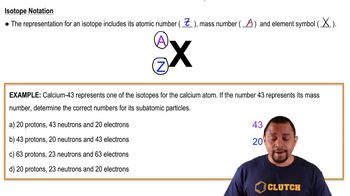
Isotopes are atoms of the same element with different numbers of neutrons, affecting their mass number. Atomic notation shows the element symbol with its mass number (protons + neutrons) as a superscript and atomic number (protons) as a subscript. For 58Ni, 58 is the mass number, and Ni is the element symbol.
Video consigliato:
Percorso guidato
03:57
Isotope Notation Example

Formation of Ions by Electron Removal

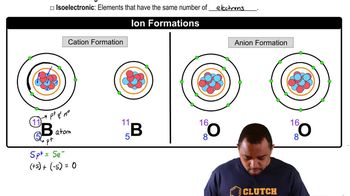
Ions form when atoms gain or lose electrons. Removing electrons creates a positively charged ion (cation). The charge equals the number of electrons lost, so removing two electrons from a neutral atom results in a 2+ charge.
Video consigliato:

Writing Ion Symbols

Ion symbols combine the element symbol, mass number, and charge. The mass number remains unchanged when electrons are lost or gained. The charge is indicated as a superscript with a plus or minus sign and the number of charges, e.g., Ni²⁺ for a nickel ion with two electrons removed.
Video consigliato:
Percorso guidato
03:17
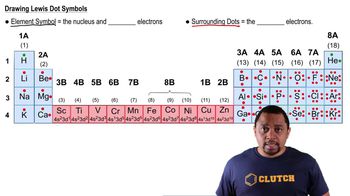
Lewis Dot Symbols