
Ch.2 - Atoms, Molecules, and Ions
Brown - Chemistry: The Central Science 14th Edition
Brown14th EditionChemistry: The Central ScienceISBN: 9780134414232Non è quello che usi tu?Cambia libro di testo
Capitolo 2, Problema 41

For each of the following elements, write its chemical symbol, locate it in the periodic table, give its atomic number, and indicate whether it is a metal, metalloid, or nonmetal: (a) radon (b) tellurium (c) cadmium (d) chromium (e) barium (f) selenium (g) arsenic.

Guida verificata passo dopo passo
1
Identify the chemical symbol for arsenic. The symbol for arsenic is As.
Locate arsenic in the periodic table. Arsenic is found in group 15 and period 4.
Determine the atomic number of arsenic. The atomic number of arsenic, which is the number of protons in its nucleus, is 33.
Classify arsenic as a metal, metalloid, or nonmetal. Arsenic is classified as a metalloid because it has properties intermediate between metals and nonmetals.
Summarize the information: Arsenic (As), located in group 15 and period 4 of the periodic table, has an atomic number of 33 and is a metalloid.

Risposta video verificata per un problema simile:

Questa soluzione video è stata consigliata dai nostri tutor come utile per risolvere questo problema.
Durata del video:
1m

Concetti chiave

Ecco i concetti essenziali che devi comprendere per rispondere correttamente alla domanda.

Periodic Table

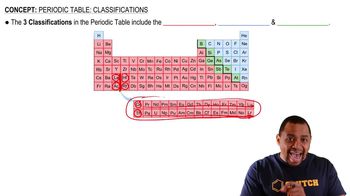
The periodic table is a systematic arrangement of chemical elements, organized by increasing atomic number. Elements are grouped into rows (periods) and columns (groups) based on similar properties. Understanding the layout of the periodic table is essential for identifying elements, their symbols, and their classifications as metals, metalloids, or nonmetals.
Video consigliato:
Percorso guidato
02:40
Periodic Table Classifications

Atomic Number

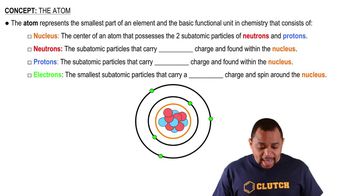
The atomic number of an element is the number of protons found in the nucleus of its atoms, which determines the element's identity and its position in the periodic table. It also indicates the number of electrons in a neutral atom, influencing the element's chemical behavior and reactivity. For arsenic, the atomic number is 33.
Video consigliato:

Classification of Elements

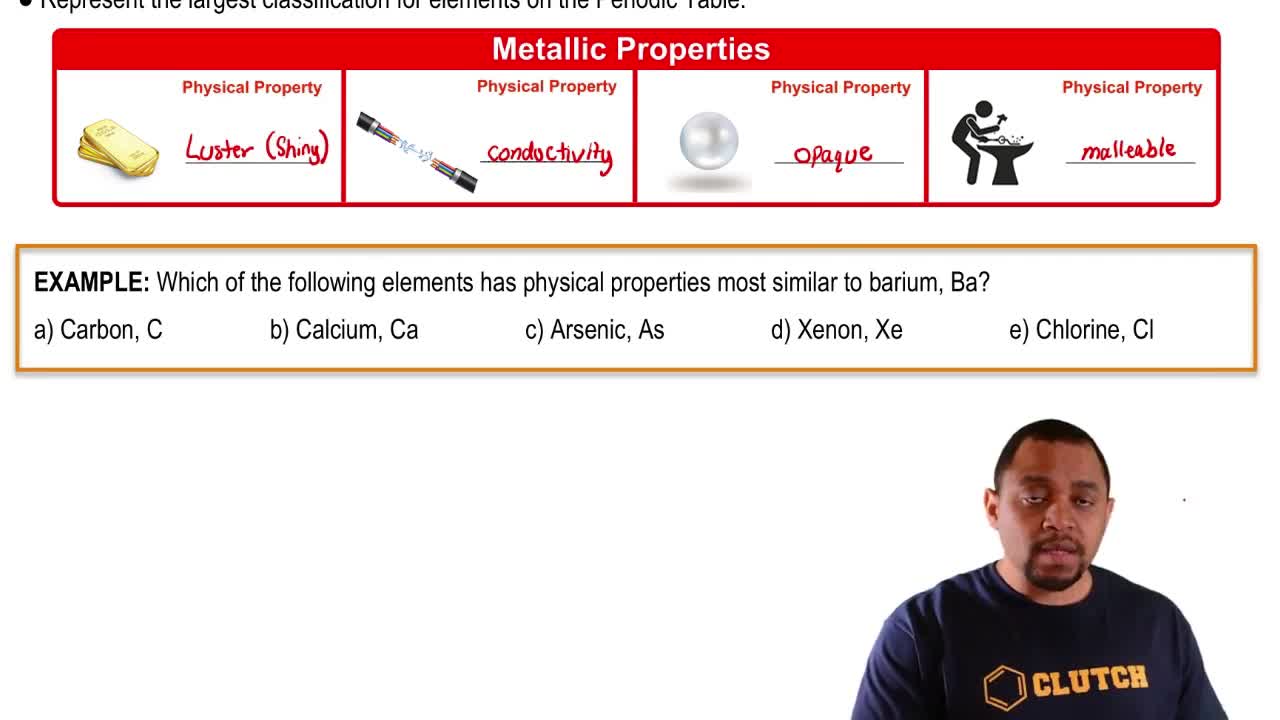
Elements are classified into three main categories: metals, metalloids, and nonmetals, based on their physical and chemical properties. Metals are typically shiny, conductive, and malleable; nonmetals are usually dull, insulative, and brittle; while metalloids exhibit properties of both. Arsenic, for example, is classified as a metalloid, which means it has characteristics of both metals and nonmetals.
Video consigliato:
Percorso guidato
01:39
Element Classification Example