Ch.2 - Atoms, Molecules, and Ions
Brown - Chemistry: The Central Science 14th Edition
Brown14th EditionChemistry: The Central ScienceISBN: 9780134414232Non è quello che usi tu?Cambia libro di testo
Capitolo 2, Problema 3a

Four of the boxes in the following periodic table are colored. Which of these are metals and which are nonmetals?

Guida verificata passo dopo passo
1
insert step 1: Identify the location of the colored boxes on the periodic table.
insert step 2: Recall that metals are typically located on the left side and in the center of the periodic table, while nonmetals are found on the right side.
insert step 3: Check if the elements in the colored boxes are in groups known for metals, such as alkali metals, alkaline earth metals, transition metals, or post-transition metals.
insert step 4: Determine if any of the colored boxes are in groups known for nonmetals, such as the halogens or noble gases.
insert step 5: Classify each element in the colored boxes as either a metal or a nonmetal based on their position and group characteristics on the periodic table.

Risposta video verificata per un problema simile:

Questa soluzione video è stata consigliata dai nostri tutor come utile per risolvere questo problema.
Durata del video:
1m

Concetti chiave

Ecco i concetti essenziali che devi comprendere per rispondere correttamente alla domanda.

Metals

Metals are elements that typically exhibit high electrical and thermal conductivity, malleability, ductility, and a shiny appearance. They are usually found on the left side and in the center of the periodic table. Common examples include iron, copper, and gold. Metals tend to lose electrons during chemical reactions, forming positive ions.
Video consigliato:
Percorso guidato
03:12
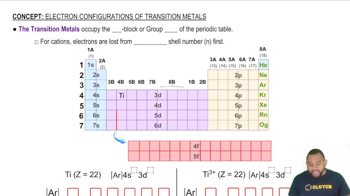
Transition Metals

Nonmetals

Nonmetals are elements that generally lack the properties of metals and are found on the right side of the periodic table. They are poor conductors of heat and electricity, and they can be gases, liquids, or solids at room temperature. Nonmetals tend to gain or share electrons in chemical reactions, forming negative ions or covalent bonds. Examples include oxygen, nitrogen, and sulfur.
Video consigliato:
Percorso guidato
01:12
Nonmetal Properties

Periodic Table Classification

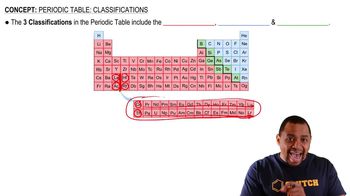
The periodic table classifies elements based on their atomic number, electron configuration, and recurring chemical properties. Elements are organized into groups (columns) and periods (rows), with metals on the left, nonmetals on the right, and metalloids in between. This classification helps predict the behavior of elements in chemical reactions and their physical properties.
Video consigliato:
Percorso guidato
02:40
Periodic Table Classifications