Ch.2 - Atoms, Molecules, and Ions
Brown - Chemistry: The Central Science 14th Edition
Brown14th EditionChemistry: The Central ScienceISBN: 9780134414232Non è quello che usi tu?Cambia libro di testo
Capitolo 2, Problema 75c

Give the name or chemical formula, as appropriate, for each of the following acids: (c) H3PO4

Guida verificata passo dopo passo
1
Identify the elements in the given chemical formula. In H3PO4, the elements are hydrogen (H), phosphorus (P), and oxygen (O).
Recognize that the formula represents an acid because it starts with hydrogen (H).
Determine the type of acid by noting the non-hydrogen elements. Since phosphorus and oxygen are present, it is an oxyacid.
Recall the naming convention for oxyacids: if the polyatomic ion ends in '-ate', the acid name will end in '-ic'. The polyatomic ion here is phosphate (PO43-).
Apply the naming convention to name the acid as phosphoric acid.

Risposta video verificata per un problema simile:

Questa soluzione video è stata consigliata dai nostri tutor come utile per risolvere questo problema.
Durata del video:
48s

Concetti chiave

Ecco i concetti essenziali che devi comprendere per rispondere correttamente alla domanda.

Acids and Their Formulas

Acids are substances that can donate protons (H⁺ ions) in a solution. The chemical formula of an acid typically starts with hydrogen, followed by the anion. For example, H₃PO₄ contains three hydrogen atoms and the phosphate ion (PO₄³⁻), indicating it is a triprotic acid capable of donating three protons.
Video consigliato:
Percorso guidato
02:08
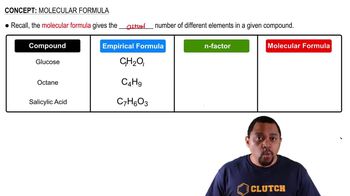
Determining Molecular Formulas

Naming Acids

The naming of acids depends on the anion present. If the anion ends in '-ate,' the acid name typically ends in '-ic,' while anions ending in '-ite' lead to names ending in '-ous.' For H₃PO₄, the anion is phosphate (PO₄³⁻), so the acid is named phosphoric acid.
Video consigliato:
Percorso guidato
02:21
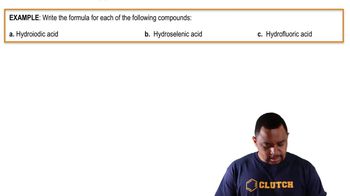
Naming Binary Acids Example

Triprotic Acids

Triprotic acids are capable of donating three protons per molecule in aqueous solution. This characteristic affects their strength and behavior in chemical reactions. H₃PO₄, or phosphoric acid, is a common example, and its ability to donate multiple protons makes it important in various chemical and biological processes.
Video consigliato:
Percorso guidato
6:47
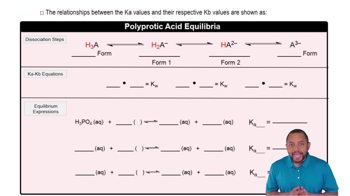
Triprotic Acid Equilibrium