Ch.2 - Atoms, Molecules, and Ions
Brown - Chemistry: The Central Science 14th Edition
Brown14th EditionChemistry: The Central ScienceISBN: 9780134414232Non è quello che usi tu?Cambia libro di testo
Capitolo 2, Problema 14b

In a series of experiments, a chemist prepared three different compounds that contain only iodine and fluorine and determined the mass of each element in each compound: Compound Mass of Iodine (g) Mass of Fluorine (g) 1 4.75 3.56 2 7.64 3.43 3 9.41 9.86 (b) How do the numbers in part (a) support the atomic theory?

Guida verificata passo dopo passo
1
Calculate the mass ratio of iodine to fluorine for each compound. This can be done by dividing the mass of iodine by the mass of fluorine for each compound.
Compare the mass ratios of iodine to fluorine across the three compounds to see if there are any simple whole number ratios. This step is crucial as it helps to determine if the compounds follow the law of multiple proportions.
Reflect on the concept of the law of multiple proportions, which states that when two elements form more than one compound, the masses of one element that combine with a fixed mass of the other element are in ratios of small whole numbers.
Analyze how the mass ratios support or contradict the atomic theory, which posits that elements are made of indivisible particles called atoms and that the atoms of a given element are identical in mass and properties.
Conclude whether the experimental data supports the atomic theory by checking if the mass ratios are consistent with the idea that compounds are formed from atoms combining in fixed, whole number ratios.

Risposta video verificata per un problema simile:

Questa soluzione video è stata consigliata dai nostri tutor come utile per risolvere questo problema.
Durata del video:
5m

Concetti chiave

Ecco i concetti essenziali che devi comprendere per rispondere correttamente alla domanda.

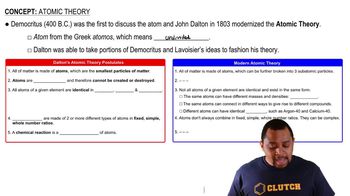
Atomic Theory

Atomic theory posits that matter is composed of discrete units called atoms, which combine in specific ratios to form compounds. This theory explains the behavior of elements and compounds, including their mass relationships. In the context of the question, the varying masses of iodine and fluorine in the compounds illustrate how different combinations of atoms can yield distinct substances, supporting the idea that atoms combine in fixed proportions.
Video consigliato:
Percorso guidato
05:22
Dalton's Atomic Theory

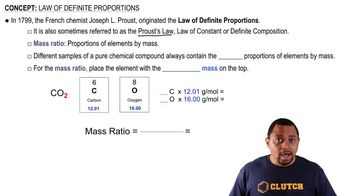
Law of Definite Proportions

The Law of Definite Proportions states that a chemical compound always contains its component elements in fixed ratio by mass, regardless of the sample size or source. This principle is crucial for understanding the data presented in the question, as the mass ratios of iodine to fluorine in each compound should reflect consistent proportions, reinforcing the atomic theory and the concept of fixed composition in compounds.
Video consigliato:
Percorso guidato
02:48
Law of Definite Proportions

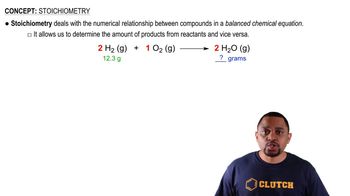
Stoichiometry

Stoichiometry is the branch of chemistry that deals with the quantitative relationships between the reactants and products in a chemical reaction. It allows chemists to predict the amounts of substances consumed and produced in a given reaction. In this question, stoichiometric calculations can be applied to analyze the mass data of iodine and fluorine, demonstrating how the ratios of these elements in the compounds align with the principles of atomic theory and the law of definite proportions.
Video consigliato:
Percorso guidato
01:16
Stoichiometry Concept
Pratica correlata
Domanda del libro di testo

A chemist finds that 30.82 g of nitrogen will react with 17.60, 35.20, 70.40, or 88.00 g of oxygen to form four different compounds. (b) How do the numbers in part (a) support Dalton's atomic theory?

895
views

Domanda del libro di testo
Discovering which of the three subatomic particles proved to be the most difficult—the proton, neutron, or electron? Why?
373
views
Domanda del libro di testo

In a series of experiments, a chemist prepared three different compounds that contain only iodine and fluorine and determined the mass of each element in each compound: Compound Mass of Iodine (g) Mass of Fluorine (g) 1 4.75 3.56 2 7.64 3.43 3 9.41 9.86 (a) Calculate the mass of fluorine per gram of iodine in Compound 3.

742
views
Domanda del libro di testo

An unknown particle is caused to move between two electrically charged plates, as illustrated in Figure 2.7. You hypothesize that the particle is a proton. (b) Would it be deflected by a smaller or larger amount than the b rays?

515
views
Domanda del libro di testo

An unknown particle is caused to move between two electrically charged plates, as illustrated in Figure 2.7. You hypothesize that the particle is a proton. (a) If your hypothesis is correct, would the particle be deflected in the same or opposite direction as the b rays?

823
views
Domanda del libro di testo

In a series of experiments, a chemist prepared three different compounds that contain only iodine and fluorine and determined the mass of each element in each compound: Compound Mass of Iodine (g) Mass of Fluorine (g) 1 4.75 3.56 2 7.64 3.43 3 9.41 9.86 (a) Calculate the mass of fluorine per gram of iodine in Compound 1 and 2.

882
views