
Ch.2 - Atoms, Molecules, and Ions
Brown - Chemistry: The Central Science 14th Edition
Brown14th EditionChemistry: The Central ScienceISBN: 9780134414232Non è quello che usi tu?Cambia libro di testo
Capitolo 2, Problema 87c

Suppose a scientist repeats the Millikan oil-drop experiment but reports the charges on the drops using an unusual (and imaginary) unit called the warmomb (wa). The scientist obtains the following data for four of the drops: Droplet Calculated Charge (wa) A 3.84⨉10−8 B 4.80⨉10−8 C 2.88⨉10−8 D 8.64⨉10−8 (c) Based on your answer to part (b), how many electrons are there on each of the droplets?

Guida verificata passo dopo passo
1
Step 1: Recall that the charge of an electron is a fundamental unit of charge. In the Millikan oil-drop experiment, the charge on each oil drop is a multiple of this fundamental charge. In part (b), you should have determined the charge of an electron in warmombs (wa).
Step 2: To find the number of electrons on each droplet, divide the charge of each droplet by the charge of an electron (in warmombs). This is because the total charge of a droplet is the product of the charge of an electron and the number of excess electrons on the droplet.
Step 3: For droplet A, divide the charge of droplet A (3.84⨉10−8 wa) by the charge of an electron in warmombs.
Step 4: Repeat this process for droplets B, C, and D. For each droplet, divide the charge of the droplet by the charge of an electron in warmombs.
Step 5: The result of each division will give you the number of excess electrons on each droplet. Note that this number should be an integer, as you cannot have a fraction of an electron.

Risposta video verificata per un problema simile:

Questa soluzione video è stata consigliata dai nostri tutor come utile per risolvere questo problema.
Durata del video:
1m

Concetti chiave

Ecco i concetti essenziali che devi comprendere per rispondere correttamente alla domanda.

Millikan Oil-Drop Experiment

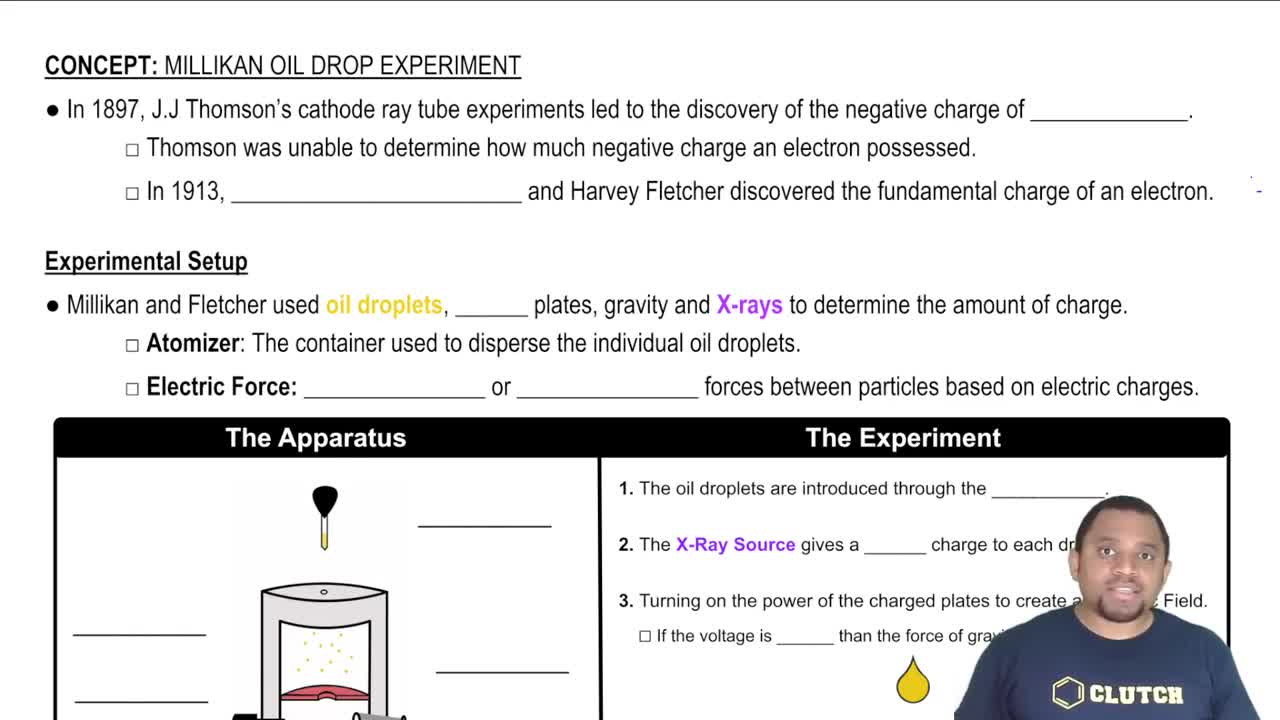
The Millikan oil-drop experiment was a groundbreaking experiment conducted by Robert Millikan in 1909 to measure the charge of the electron. By balancing the gravitational and electric forces on tiny oil droplets, Millikan was able to determine that the charge of an electron is approximately -1.6 x 10^-19 coulombs. This experiment provided crucial evidence for the quantization of electric charge.
Video consigliato:
Percorso guidato
04:44
Millikan Oil Drop

Charge Quantization

Charge quantization refers to the principle that electric charge exists in discrete units, specifically as integer multiples of the elementary charge (the charge of a single electron). In the context of the question, the charges measured in the imaginary unit 'warmomb' can be converted to the number of electrons by dividing the measured charge by the elementary charge. This concept is fundamental in understanding how charges interact and combine.
Video consigliato:

Unit Conversion

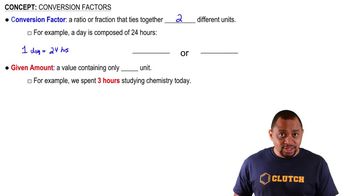
Unit conversion is the process of converting a quantity expressed in one unit to another unit. In this scenario, the scientist reports charges in an unusual unit called 'warmomb.' To determine the number of electrons on each droplet, one must convert the charge from warmombs to coulombs, using the relationship between the two units. This step is essential for accurately calculating the number of electrons based on the known charge of an electron.
Video consigliato:
Percorso guidato
01:56
Conversion Factors
Pratica correlata
Domanda del libro di testo

Suppose a scientist repeats the Millikan oil-drop experiment but reports the charges on the drops using an unusual (and imaginary) unit called the warmomb (wa). The scientist obtains the following data for four of the drops: Droplet Calculated Charge (wa) A 3.84⨉10−8 B 4.80⨉10−8 C 2.88⨉10−8 D 8.64⨉10−8 (b) From these data, what is the best choice for the charge of the electron in warmombs?

804
views
1
comments
Domanda del libro di testo

Suppose a scientist repeats the Millikan oil-drop experiment but reports the charges on the drops using an unusual (and imaginary) unit called the warmomb (wa). The scientist obtains the following data for four of the drops: Droplet Calculated Charge (wa) A 3.84⨉10−8 B 4.80⨉10−8 C 2.88⨉10−8 D 8.64⨉10−8 (d) What is the conversion factor between warmombs and coulombs?

1459
views
Domanda del libro di testo

The natural abundance of 3He is 0.000137%. (a) How many protons, neutrons, and electrons are in an atom of 3He?

807
views
Domanda del libro di testo

The natural abundance of 3He is 0.000137%. (b) Based on the sum of the masses of their subatomic particles, which is expected to be more massive, an atom of 3He or an atom of 3H (which is also called tritium)?

906
views
Domanda del libro di testo

Suppose a scientist repeats the Millikan oil-drop experiment but reports the charges on the drops using an unusual (and imaginary) unit called the warmomb (wa). The scientist obtains the following data for four of the drops: Droplet Calculated Charge (wa) A 3.84⨉10−8 B 4.80⨉10−8 C 2.88⨉10−8 D 8.64⨉10−8 (a) If all the droplets were the same size, which would fall most slowly through the apparatus?

926
views