Ch.2 - Atoms, Molecules, and Ions
Brown - Chemistry: The Central Science 14th Edition
Brown14th EditionChemistry: The Central ScienceISBN: 9780134414232Non è quello che usi tu?Cambia libro di testo
Capitolo 2, Problema 95

The element chromium (Cr) consists of four naturally occurring isotopes with atomic masses 49.9460, 51.9405, 52.9407, and 53.9389 u. The relative abundances of these four isotopes are 4.3, 83.8, 9.5, and 2.4%, respectively. From these data, calculate the atomic weight of chromium.

Guida verificata passo dopo passo
1
Identify the isotopes of chromium and their respective atomic masses: 49.9460 u, 51.9405 u, 52.9407 u, and 53.9389 u.
Identify the relative abundances of each isotope: 4.3%, 83.8%, 9.5%, and 2.4%.
Convert the percentage abundances into decimal form by dividing each by 100: 0.043, 0.838, 0.095, and 0.024.
Calculate the contribution of each isotope to the atomic weight by multiplying the atomic mass of each isotope by its decimal abundance: (49.9460 u * 0.043), (51.9405 u * 0.838), (52.9407 u * 0.095), (53.9389 u * 0.024).
Sum the contributions from all isotopes to find the atomic weight of chromium.

Risposta video verificata per un problema simile:

Questa soluzione video è stata consigliata dai nostri tutor come utile per risolvere questo problema.
Durata del video:
3m

Concetti chiave

Ecco i concetti essenziali che devi comprendere per rispondere correttamente alla domanda.

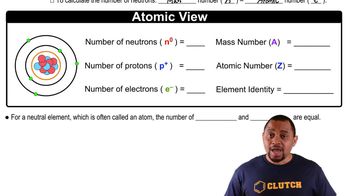
Isotopes

Isotopes are variants of a chemical element that have the same number of protons but different numbers of neutrons, resulting in different atomic masses. For example, chromium has four isotopes, each with a unique atomic mass, which contributes to the element's average atomic weight based on their relative abundances.
Video consigliato:

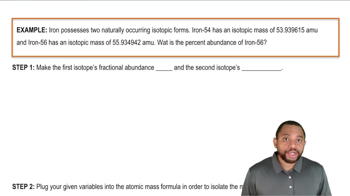
Relative Abundance

Relative abundance refers to the proportion of each isotope of an element present in a sample, usually expressed as a percentage. In the case of chromium, the isotopes have specific relative abundances that must be considered when calculating the weighted average atomic mass of the element.
Video consigliato:
Percorso guidato
5:41
Calculating Abundance Example

Weighted Average

The weighted average is a calculation that takes into account the different weights (or contributions) of each component in a dataset. To find the atomic weight of chromium, the atomic masses of its isotopes are multiplied by their respective relative abundances, and the results are summed and divided by 100 to yield the average atomic weight.
Video consigliato:
Percorso guidato
02:03
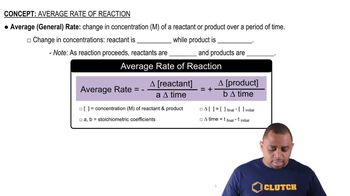
Average Rate of Reaction
Pratica correlata
Domanda del libro di testo

The element argon has three naturally occurring isotopes, with 18, 20, and 22 neutrons in the nucleus, respectively. (a) Write the full chemical symbols for these three isotopes.

1891
views

Domanda del libro di testo

The nucleus of 6Li is a powerful absorber of neutrons. It exists in the naturally occurring metal to the extent of 7.5%. In the era of nuclear deterrence, large quantities of lithium were processed to remove 6Li for use in hydrogen bomb production. The lithium metal remaining after removal of 6Li was sold on the market. (b) The atomic masses of 6Li and 7Li are 6.015122 and 7.016004 u, respectively. A sample of lithium depleted in the lighter isotope was found on analysis to contain 1.442% 6Li. What is the average atomic weight of this sample of the metal?

935
views
Domanda del libro di testo

Copper (Cu) consists of two naturally occurring isotopes with masses of 62.9296 and 64.9278 u. (a) How many protons and neutrons are in the nucleus of each isotope? Write the complete atomic symbol for each, showing the atomic number and mass number. (b) The average atomic mass of Cu is 63.55 u. Calculate the abundance of each isotope.

2066
views
Domanda del libro di testo

There are two different isotopes of bromine atoms. Under normal conditions, elemental bromine consists of Br2 molecules, and the mass of a Br2 molecule is the sum of the masses of the two atoms in the molecule. The mass spectrum of Br2 consists of three peaks: Mass (u) Relative Size 157.836 0.2569 159.834 0.4999 161.832 0.2431 (a) What is the origin of each peak (of what isotopes does each consist)?

548
views