What are the molecular and empirical formulas for each of the following compounds? Write the molecular formula for the following compound.
Ch.2 - Atoms, Molecules, and Ions
Brown14th EditionChemistry: The Central ScienceISBN: 9780134414232Non è quello che usi tu?Cambia libro di testo
Capitolo 2, Problema 45c
The structural formulas of the compounds n-butane and isobutane are shown below. (c) Which formulas—empirical, molecular, or structural—allow you determine these are different compounds?

Guida verificata passo dopo passo1
Step 1: Understand the types of chemical formulas: Empirical formulas show the simplest whole-number ratio of atoms in a compound, molecular formulas show the actual number of each type of atom in a molecule, and structural formulas show the arrangement of atoms within the molecule.
Step 2: Examine the structural formulas of n-pentane and isopentane provided in the image. Notice the different arrangements of carbon and hydrogen atoms.
Step 3: Compare the molecular formulas of n-pentane and isopentane. Both have the same molecular formula, C5H12, indicating they are isomers.
Step 4: Compare the empirical formulas of n-pentane and isopentane. Both have the same empirical formula, C5H12, as it is the simplest ratio of atoms.
Step 5: Conclude that the structural formulas are necessary to determine that n-pentane and isopentane are different compounds, as they show the different arrangements of atoms.

Risposta video verificata per un problema simile:
Questa soluzione video è stata consigliata dai nostri tutor come utile per risolvere questo problema.
Durata del video:
37sConcetti chiave
Ecco i concetti essenziali che devi comprendere per rispondere correttamente alla domanda.
Structural Isomerism
Structural isomerism occurs when compounds have the same molecular formula but different structural formulas. In the case of n-pentane and isopentane, both have the molecular formula C5H12, yet their structural arrangements differ, leading to distinct physical and chemical properties. Understanding this concept is crucial for identifying how compounds can be classified as different despite having the same number of atoms.
Video consigliato:
Percorso guidato
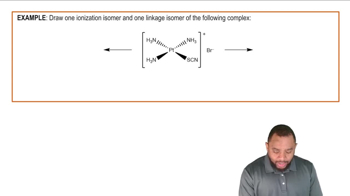
Isomerism in Coordination Complexes Example
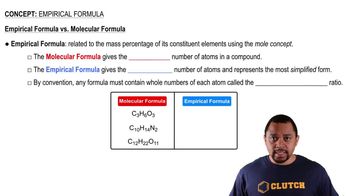
Empirical vs. Molecular vs. Structural Formulas
Empirical formulas represent the simplest whole-number ratio of elements in a compound, while molecular formulas indicate the actual number of each type of atom present. Structural formulas provide a visual representation of how atoms are connected. To determine that n-pentane and isopentane are different compounds, one must analyze their structural formulas, as they reveal the distinct arrangements of atoms that define each compound.
Video consigliato:
Percorso guidato
Empirical vs Molecular Formula
Chemical Properties and Reactivity
The chemical properties and reactivity of compounds can vary significantly based on their structure. Isomers, such as n-pentane and isopentane, may exhibit different boiling points, melting points, and reactivity due to their unique arrangements of atoms. Recognizing these differences is essential for understanding how structural variations influence the behavior of chemical substances.
Video consigliato:
Percorso guidato
Chemical Properties
Pratica correlata
Domanda del libro di testo
532
views
Domanda del libro di testo
The structural formulas of the compounds n-butane and isobutane are shown below. (b) Determine the empirical formula of each.
815
views
Domanda del libro di testo
For each of the following elements, write its chemical symbol, determine the name of the group to which it belongs (Table 2.3), and indicate whether it is a metal, metalloid, or nonmetal: (a) polonium (b) strontium (c) neon (d) rubidium (e) sulfur.
603
views
Domanda del libro di testo
Two substances have the same molecular and empirical formulas. Does this mean that they must be the same compound?
922
views
Domanda del libro di testo
Ball-and-stick representations of benzene, a colorless liquid often used in organic chemistry reactions, and acetylene, a gas used as a fuel for high-temperature welding, are shown below. (a) Determine the molecular formula of each.
427
views