Ch.2 - Atoms, Molecules, and Ions
Brown - Chemistry: The Central Science 14th Edition
Brown14th EditionChemistry: The Central ScienceISBN: 9780134414232Non è quello che usi tu?Cambia libro di testo
Capitolo 2, Problema 49a

Write the empirical formula corresponding to each of the following molecular formulas: (a) Al2Br6

Guida verificata passo dopo passo
1
Identify the molecular formula given: \( \text{Al}_2\text{Br}_6 \).
Determine the greatest common divisor (GCD) of the subscripts in the molecular formula. Here, the subscripts are 2 and 6.
Divide each subscript in the molecular formula by the GCD to simplify the ratio. The GCD of 2 and 6 is 2.
Divide the subscript of Al (2) by 2 to get 1, and the subscript of Br (6) by 2 to get 3.
Write the empirical formula using the simplified subscripts: \( \text{AlBr}_3 \).

Risposta video verificata per un problema simile:

Questa soluzione video è stata consigliata dai nostri tutor come utile per risolvere questo problema.
Durata del video:
1m

Concetti chiave

Ecco i concetti essenziali che devi comprendere per rispondere correttamente alla domanda.

Empirical Formula

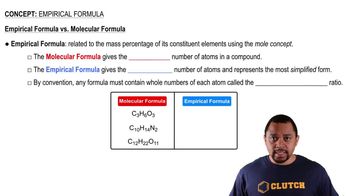
The empirical formula of a compound represents the simplest whole-number ratio of the elements present in that compound. It does not provide information about the actual number of atoms in a molecule but rather the relative proportions of each element. For example, the empirical formula for glucose (C6H12O6) is CH2O, indicating a 1:2:1 ratio of carbon, hydrogen, and oxygen.
Video consigliato:
Percorso guidato
02:26
Empirical vs Molecular Formula

Molecular Formula

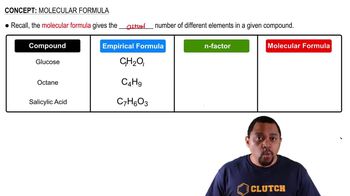
The molecular formula indicates the actual number of atoms of each element in a molecule of a compound. It can be the same as the empirical formula or a multiple of it. For instance, the molecular formula C6H12O6 shows that there are six carbon atoms, twelve hydrogen atoms, and six oxygen atoms in each molecule of glucose, which is a multiple of its empirical formula CH2O.
Video consigliato:
Percorso guidato
02:08
Determining Molecular Formulas

Reduction of Ratios

To derive the empirical formula from a molecular formula, one must reduce the ratios of the elements to their simplest form. This involves dividing the subscripts in the molecular formula by their greatest common divisor. For example, in Al2Br6, both subscripts can be divided by 2, resulting in the empirical formula AlBr3, which reflects the simplest ratio of aluminum to bromine.
Video consigliato:
Percorso guidato
02:14
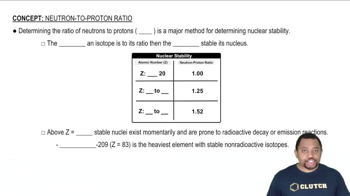
Neutron-Proton Ratio