Ch.20 - Electrochemistry
Brown - Chemistry: The Central Science 14th Edition
Brown14th EditionChemistry: The Central ScienceISBN: 9780134414232Non è quello che usi tu?Cambia libro di testo
Capitolo 20, Problema 36c

A voltaic cell that uses the reaction PdCl42-(aq) + Cd(s) → Pd(s) + 4 Cl-(aq) + Cd2+(aq) has a measured standard cell potential of +1.03 V. (c) Sketch the voltaic cell, label the anode and cathode, and indicate the direction of electron flow

Guida verificata passo dopo passo
1
Identify the oxidation and reduction half-reactions. In this reaction, Cd(s) is oxidized to Cd2+(aq), and PdCl4^2-(aq) is reduced to Pd(s).
Determine the anode and cathode. The anode is where oxidation occurs, so Cd(s) is the anode. The cathode is where reduction occurs, so PdCl4^2-(aq) is the cathode.
Sketch the voltaic cell. Draw two compartments: one for the anode and one for the cathode. Connect them with a salt bridge to allow the flow of ions.
Label the anode and cathode in your sketch. The anode (Cd) should be on the left, and the cathode (Pd) should be on the right.
Indicate the direction of electron flow. Electrons flow from the anode to the cathode through the external circuit. In this case, electrons flow from the Cd electrode to the Pd electrode.

Risposta video verificata per un problema simile:

Questa soluzione video è stata consigliata dai nostri tutor come utile per risolvere questo problema.
Durata del video:
2m

Concetti chiave

Ecco i concetti essenziali che devi comprendere per rispondere correttamente alla domanda.

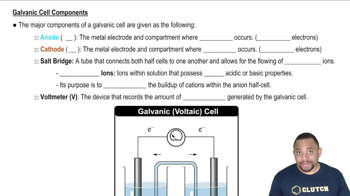
Voltaic Cell Components

A voltaic cell, also known as a galvanic cell, consists of two electrodes: the anode and the cathode, immersed in an electrolyte solution. The anode is where oxidation occurs, releasing electrons, while the cathode is where reduction takes place, accepting electrons. Understanding these components is essential for sketching the cell and labeling its parts correctly.
Video consigliato:
Percorso guidato
03:55
Galvanic Cell Components

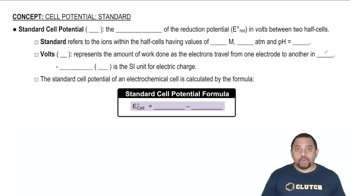
Standard Cell Potential

The standard cell potential (E°) is a measure of the voltage produced by a voltaic cell under standard conditions (1 M concentration, 1 atm pressure, and 25°C). It indicates the driving force behind the electrochemical reaction, with a positive value suggesting a spontaneous reaction. In this case, the +1.03 V indicates that the reaction is favorable and helps determine the direction of electron flow.
Video consigliato:
Percorso guidato
01:27
Standard Cell Potential

Electron Flow Direction

In a voltaic cell, electrons flow from the anode to the cathode through an external circuit. This flow occurs because the anode is negatively charged (due to oxidation) and the cathode is positively charged (due to reduction). Understanding this flow is crucial for accurately sketching the cell and indicating the movement of electrons during the electrochemical reaction.
Video consigliato:
Percorso guidato
04:44
Electron Geometry