Ch.20 - Electrochemistry
Brown - Chemistry: The Central Science 14th Edition
Brown14th EditionChemistry: The Central ScienceISBN: 9780134414232Non è quello che usi tu?Cambia libro di testo
Capitolo 20, Problema 48

Based on the data in Appendix E, (a) which of the following is the strongest oxidizing agent, and which is the weakest in acidic solution: Br2, H2O2, Zn, Cr2O72-?

Guida verificata passo dopo passo
1
Step 1: Understand that an oxidizing agent is a substance that gains electrons in a redox reaction, causing another substance to be oxidized.
Step 2: Refer to Appendix E, which contains standard reduction potentials (E° values) for various half-reactions. These values indicate the tendency of a species to gain electrons and be reduced.
Step 3: Identify the half-reactions for each species in the problem: Br2, H2O2, Zn, and Cr2O7^2-. Look for their corresponding E° values in acidic solution.
Step 4: Compare the E° values of the half-reactions. The species with the highest E° value is the strongest oxidizing agent because it has the greatest tendency to gain electrons.
Step 5: Determine the weakest oxidizing agent by identifying the species with the lowest E° value, as it has the least tendency to gain electrons.

Concetti chiave

Ecco i concetti essenziali che devi comprendere per rispondere correttamente alla domanda.

Oxidizing Agents

An oxidizing agent is a substance that gains electrons in a chemical reaction, causing another substance to be oxidized. The strength of an oxidizing agent is determined by its ability to accept electrons; stronger oxidizers have a higher reduction potential. In acidic solutions, the relative strengths of oxidizing agents can be compared using standard reduction potentials, which indicate how readily a species can be reduced.
Video consigliato:
Percorso guidato
01:01
Oxidizing and Reducing Agents

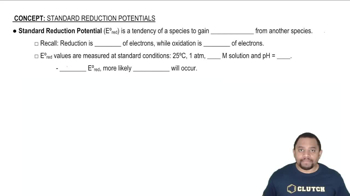
Standard Reduction Potentials

Standard reduction potentials (E°) are measured under standard conditions and indicate the tendency of a chemical species to be reduced. Each half-reaction has a specific E° value, and these values can be used to rank the strength of oxidizing agents. A higher E° value corresponds to a stronger oxidizing agent, as it indicates a greater likelihood of gaining electrons.
Video consigliato:
Percorso guidato
01:10
Standard Reduction Potentials

Acidic Solution Effects

In acidic solutions, the presence of protons (H⁺ ions) can influence the behavior of oxidizing agents. Some species may have different reduction potentials in acidic conditions compared to neutral or basic conditions. Understanding how the pH affects the stability and reactivity of the oxidizing agents is crucial for accurately determining which is the strongest and weakest in the given context.
Video consigliato:
Percorso guidato
00:33
Common Ion Effect in Acids and Bases