Ch.20 - Electrochemistry
Brown - Chemistry: The Central Science 14th Edition
Brown14th EditionChemistry: The Central ScienceISBN: 9780134414232Non è quello che usi tu?Cambia libro di testo
Capitolo 20, Problema 109

Calculate the number of kilowatt-hours of electricity required to produce 1.0 * 103 kg (1 metric ton) of aluminum by electrolysis of Al3+ if the applied voltage is 4.50 V and the process is 45% efficient.

Guida verificata passo dopo passo
1
Identify the electrochemical reaction for the production of aluminum: \( \text{Al}^{3+} + 3e^- \rightarrow \text{Al} \).
Calculate the moles of aluminum in 1.0 \(\times\) 10^3 \(\text{ kg}\) using the molar mass of aluminum (26.98 \(\text{ g/mol}\)).
Determine the total charge required using Faraday's law: \( Q = n \times F \), where \( n \) is the moles of electrons and \( F \) is Faraday's constant (96485 C/mol).
Calculate the electrical energy required using the formula \( E = Q \times V \), where \( V \) is the applied voltage (4.50 V).
Adjust for the efficiency of the process (45%) to find the actual energy consumed, and convert this energy from joules to kilowatt-hours.

Risposta video verificata per un problema simile:

Questa soluzione video è stata consigliata dai nostri tutor come utile per risolvere questo problema.
Durata del video:
4m

Concetti chiave

Ecco i concetti essenziali che devi comprendere per rispondere correttamente alla domanda.

Electrolysis

Electrolysis is a chemical process that uses electrical energy to drive a non-spontaneous reaction. In the case of aluminum production, an electric current is passed through a molten aluminum oxide solution, causing the Al3+ ions to gain electrons and form aluminum metal. Understanding the principles of electrolysis, including Faraday's laws, is essential for calculating the energy requirements for the process.
Video consigliato:
Percorso guidato
01:21
The Electrolytic Cell

Efficiency

Efficiency in a chemical process refers to the ratio of useful output to the total input, often expressed as a percentage. In this context, the 45% efficiency indicates that only 45% of the electrical energy supplied is effectively used for the electrolysis of aluminum. This concept is crucial for determining the actual energy consumption needed to produce the desired amount of aluminum.
Video consigliato:
Percorso guidato
01:41
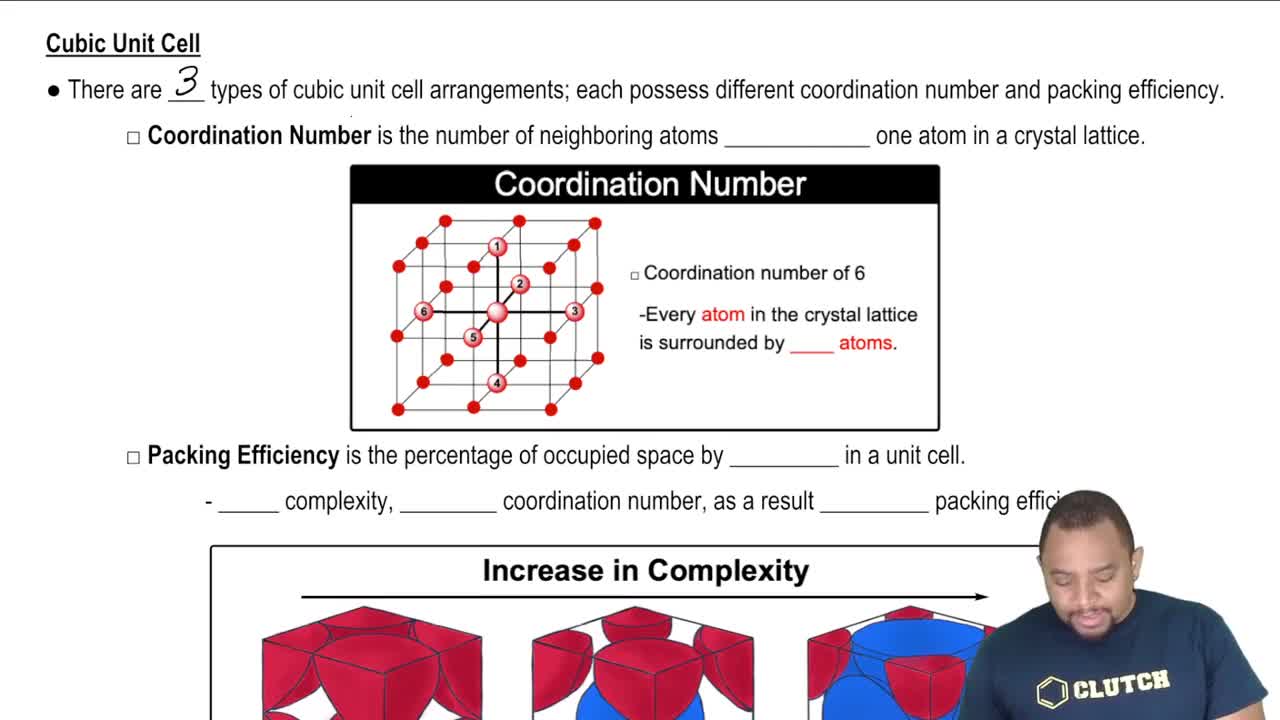
Cubic Unit Cells

Kilowatt-Hour (kWh)

A kilowatt-hour (kWh) is a unit of energy equivalent to one kilowatt (1 kW) of power used for one hour. It is commonly used to measure electrical energy consumption. In this problem, calculating the total kWh required involves converting the energy needed for the electrolysis process into this unit, taking into account the voltage applied and the efficiency of the process.
Video consigliato:
Percorso guidato
01:14
Nature of Energy