Ch.20 - Electrochemistry
Brown - Chemistry: The Central Science 14th Edition
Brown14th EditionChemistry: The Central ScienceISBN: 9780134414232Non è quello che usi tu?Cambia libro di testo
Capitolo 20, Problema 16a,b

Indicate whether each of the following statements is true or false: (a) If something is reduced, it is formally losing electrons. (b) A reducing agent gets oxidized as it reacts.

Guida verificata passo dopo passo
1
Step 1: Understand the concept of reduction. Reduction is a chemical reaction that involves the gain of electrons by a molecule, atom, or ion. Therefore, if something is reduced, it is gaining electrons, not losing them.
Step 2: Analyze statement (a). The statement claims that if something is reduced, it is losing electrons. Based on the definition of reduction, this statement is false because reduction involves gaining electrons.
Step 3: Understand the concept of a reducing agent. A reducing agent is a substance that donates electrons to another substance, causing the other substance to be reduced. In the process, the reducing agent itself gets oxidized.
Step 4: Analyze statement (b). The statement claims that a reducing agent gets oxidized as it reacts. This is true because, by definition, a reducing agent loses electrons and is oxidized while reducing another substance.
Step 5: Summarize the analysis. Statement (a) is false because reduction involves gaining electrons, not losing them. Statement (b) is true because a reducing agent is oxidized as it donates electrons to another substance.

Risposta video verificata per un problema simile:

Questa soluzione video è stata consigliata dai nostri tutor come utile per risolvere questo problema.
Durata del video:
51s

Concetti chiave

Ecco i concetti essenziali che devi comprendere per rispondere correttamente alla domanda.

Reduction and Oxidation

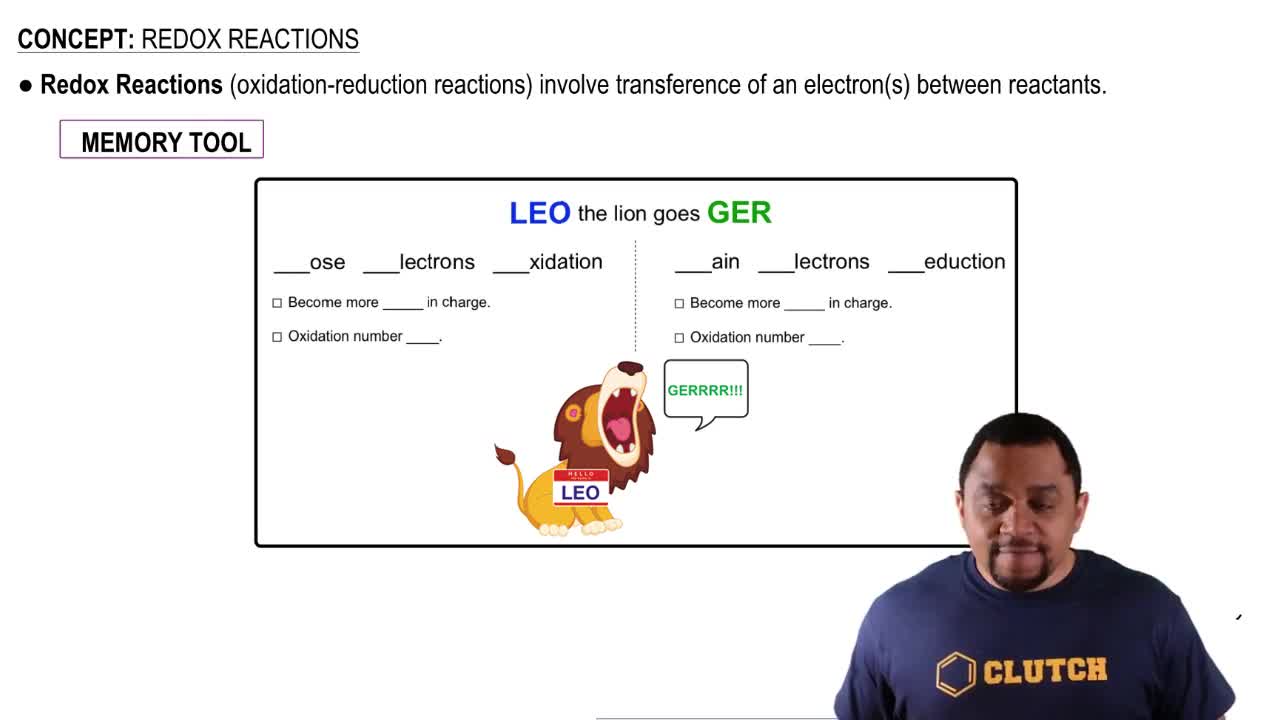
Reduction and oxidation are chemical processes that involve the transfer of electrons between substances. Reduction refers to the gain of electrons, leading to a decrease in oxidation state, while oxidation involves the loss of electrons, resulting in an increase in oxidation state. Understanding these processes is crucial for analyzing redox reactions.
Video consigliato:
Percorso guidato
01:53
Oxidation and Reduction Reactions

Reducing Agents

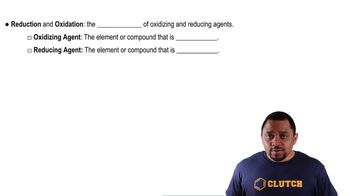
A reducing agent is a substance that donates electrons to another substance in a redox reaction, causing the other substance to be reduced. As the reducing agent loses electrons, it itself is oxidized. This dual role is essential for understanding how redox reactions function and the behavior of different chemical species.
Video consigliato:
Percorso guidato
01:01
Oxidizing and Reducing Agents

True/False Statements in Chemistry

In chemistry, evaluating statements as true or false often requires a clear understanding of definitions and principles. For example, knowing the correct definitions of reduction and oxidation helps in determining the validity of statements regarding electron transfer and the behavior of reducing agents in reactions.
Video consigliato:
Percorso guidato
01:29
Introduction to Organic Chemistry Example
Pratica correlata
Domanda del libro di testo

Indicate whether each of the following statements is true or false: (a) If something is oxidized, it is formally losing electrons.

578
views

Domanda del libro di testo

Indicate whether each of the following statements is true or false: (c) An oxidizing agent is needed to convert CO into CO2.

650
views
Domanda del libro di testo

Indicate whether each of the following statements is true or false: (c) If there are no changes in the oxidation state of the reactants or products of a particular reaction, that reaction is not a redox reaction.

728
views
Domanda del libro di testo

Indicate whether each of the following statements is true or false: (b) For the reaction Fe3+(aq) + Co2+(aq) → Fe2+(aq) + Co3+(aq), Fe3+(aq) is the reducing agent and Co2+(aq) is the oxidizing agent.

1
views
Domanda del libro di testo

For each of the following balanced oxidation–reduction reactions, (i) identify the oxidation numbers for all the elements in the reactants and products and (ii) state the total number of electrons transferred in each reaction. (a) I2O5(s) + 5 CO(g) → I2(s) + 5 CO2(g) (b) 2 Hg2+(aq) + N2H4(aq) → 2 Hg(l) + N2(g) + 4 H+(aq) (c) 3 H2S(aq) + 2 H+(aq) + 2 NO3-(aq) → 3 S(s) + 2 NO(g) + 4 H2O(l)

554
views
Domanda del libro di testo

For each of the following balanced oxidation–reduction reactions, (i) identify the oxidation numbers for all the elements in the reactants and products and (ii) state the total number of electrons transferred in each reaction. (a) 2 MnO4-(aq) + 3 S2-(aq + 4 H2O(l) → 3 S(s) + 2 MnO2(s) + 8 OH-(aq) (b) 4 H2O2(aq) + Cl2O7(g) + 2 OH-(aq) → 2 ClO2-(aq) + 5 H2O(l) + 4 O2(g) (c) Ba2+(aq) + 2 OH-(aq) + H2O2(aq) + 2 ClO2(aq) → Ba(ClO2)2(s) + 2 H2O(l) + O2(g)

718
views